Meta Killed Instagram Encryption. All 2B Users.
On May 8, 2026, Meta removed end-to-end encryption from Instagram direct messages.
Two billion users. Every DM. Readable.
Not hacked. Not leaked. Not stolen. Deliberately opened by the company that promised you a privacy-focused future. By the company whose CEO published a manifesto in 2019 titled "A Privacy-Focused Vision for Social Networking."
That vision lasted seven years. Then it became inconvenient.
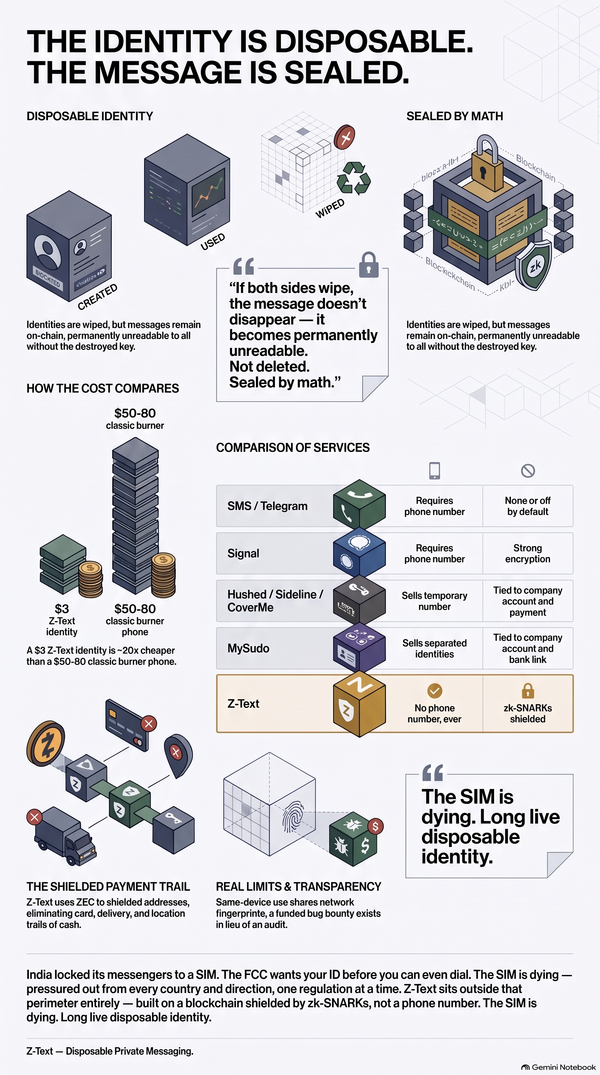
This post is about what Meta did, why Meta did it, and why it was always going to happen. And it is about Z-TEXT — the only messenger whose privacy cannot be removed by a board decision, a policy change, or a government request. Z-TEXT is built on the BitcoinZ blockchain using zk-SNARKs. Its privacy is mathematics. Not a promise.
❓ What exactly did Meta do on May 8, 2026?
Meta removed the option for end-to-end encrypted direct messages on Instagram. The feature had existed since 2023 — optional, buried deep in settings, never enabled by default.
From May 8, that option is gone. For everyone. Permanently.
Every Instagram DM you send now travels through Meta's servers in a form Meta can read. Every image. Every voice note. Every private conversation between two people who thought they were alone.
Meta's explanation was six words: "Very few people were opting in."
Read that again. Not "we're making encryption the default." Not "we're making it easier to find." They buried the feature, watched almost nobody discover it, then used low adoption as the reason to kill it entirely.
That is not a privacy decision. That is a business decision wearing a safety jacket.
❓ Who reacted and what did they say?
The reaction was immediate and damning.
The Electronic Frontier Foundation criticised Meta directly, pointing out that low adoption was entirely predictable — most users never even knew the feature existed because it was never made the default.
The Global Encryption Coalition published a statement in April saying: "Encryption is not just a feature. It is fundamental to safety and the exercise of human rights."
Proton's editor Edward Komanda warned that private Instagram messages — including photos and sensitive content — could now become accessible to Meta and used for advertising, AI training, or shared with third parties.
Privacy International noted this fits a broader pattern — platforms consistently frame surveillance as safety, while expanding their access to user data for commercial purposes.
And TikTok? TikTok announced the same week it won't implement end-to-end encryption at all. Their reason: encryption "complicates safety team and law enforcement investigations." Two of the world's biggest platforms. Same week. Same direction. Same outcome for your privacy.
❓ What is the real reason Meta killed encryption?
There are three reasons. And Meta is only admitting to one of them.
Reason 1 — The law. The Take It Down Act comes into force in the United States on May 19, 2026 — eleven days after Meta removed encryption. This law requires platforms to remove certain content within 48 hours of receiving a removal notice. You cannot comply with a takedown notice for content inside an encrypted message if you cannot see the message. Meta removed encryption eleven days before the law kicked in.
Reason 2 — The money. With encryption removed, Meta can scan Instagram DMs. That means advertising algorithms can learn from your private conversations. AI models can be trained on your messages. Your most intimate digital communications become data. Data is Meta's business.
Reason 3 — The promise they never intended to keep. In 2019 Zuckerberg's manifesto promised privacy across all Meta platforms. Internal documents from the same year showed Meta had already warned itself that encryption would hurt its ability to monitor content. The promise and the plan were always in conflict. The plan won.
❓ What can Meta do with your Instagram DMs now?
| What Meta can now do | What this means for you |
| Read message content | Your private words are no longer private |
| Scan images and voice notes | Every photo you send can be analysed |
| Use content for AI training | Your conversations feed Meta's models |
| Target ads based on DMs | What you discuss privately shapes what ads you see |
| Hand content to law enforcement | Any government with legal process can now request your DMs |
Meta has not committed to any timeline for how long DM content will be retained. Meta has not explained whether messages will be used for ad targeting. Meta has not told users what happens to conversations previously stored with encryption — those have been migrated to storage accessible by Meta.
Think of it this way. Before May 8, your Instagram DM was a sealed letter. After May 8, it is a postcard. Meta can read it. Their systems can scan it. Governments can request it. Advertisers can learn from it.
❓ Does this mean WhatsApp is next?
Meta says no. WhatsApp encryption remains the default and is not being removed.
But here is what we know. In 2019 Meta added WhatsApp encryption despite internal warnings it would hurt content moderation. In 2026 Meta removed Instagram encryption citing low opt-in rates it deliberately engineered. Yesterday Meta launched WhatsApp incognito mode — a privacy feature for AI chats — while simultaneously owning the platform that just stripped privacy from two billion users.
Meta's privacy is always conditional. It exists while it is convenient. It disappears when it becomes expensive.
And that is the fundamental problem with trusting any centralised platform with your private communications. The platform owns the infrastructure. The platform can change the rules. The platform always will — when the law, the money, or the board demands it.
❓ What is the alternative?
Privacy that cannot be switched off.
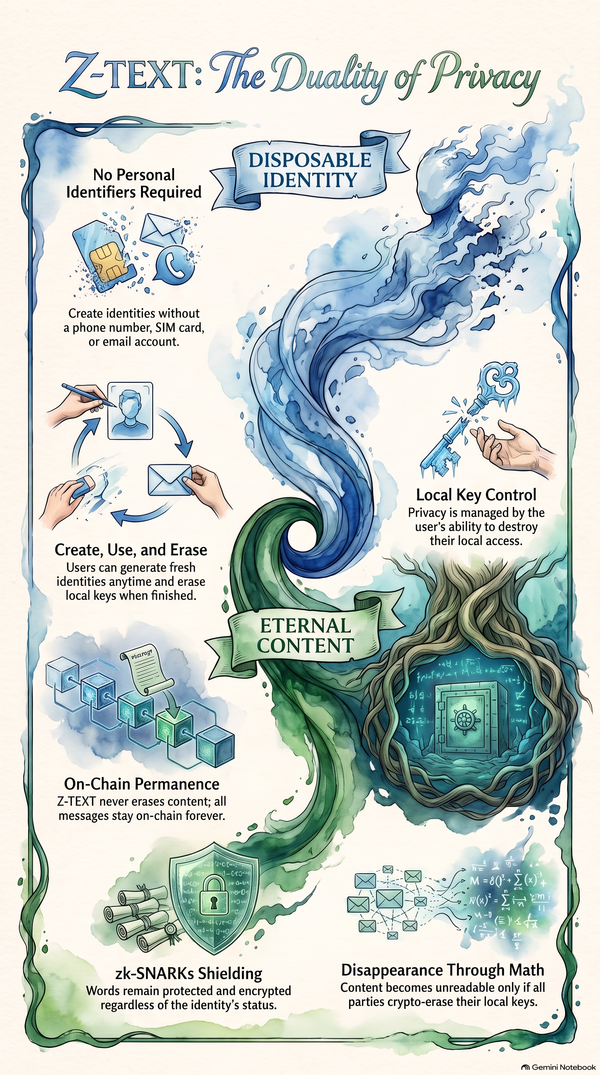
Z-TEXT is a shielded messenger, password manager, and crypto wallet — three tools in one — built on the BitcoinZ blockchain since 2017. Z-TEXT uses zk-SNARKs — Zero-Knowledge Succinct Non-Interactive Arguments of Knowledge — to hide message content and metadata at the cryptographic level.
There is no Z-TEXT board that can vote to remove your encryption. There is no Z-TEXT policy team that can quietly update a help page. There is no Z-TEXT server that a government can subpoena. The privacy is in the mathematics. Mathematics does not change because a law comes into force eleven days later.
Z-TEXT requires no phone number. Z-TEXT uses no IP address. Z-TEXT needs no VPN and no Tor. Your identity is a cryptographic z-address generated from your 24-word seed phrase. No carrier issued it. No company registered it. No government knows it exists.
And Z-TEXT costs $129 one time. Not per month. Not per year. Once. That is $0.0071 per day over 50 years. Less than a Doliprane per week.
Learn more about end-to-end encryption and why default encryption matters on Wikipedia.
The verdict
Meta betrayed two billion people on May 8, 2026.
Not with a hack. Not with a leak. With a decision. A deliberate, calculated, legally convenient decision to make your private messages readable.
And the lesson is not just about Instagram. The lesson is about centralised platforms. Every centralised platform — no matter what it promises — can change its mind. Every central server can be compelled. Every policy can be reversed.
The only privacy that cannot be taken away is privacy that was never given to anyone in the first place.
Z-TEXT never gave it away. Z-TEXT never had a central server to give. Z-TEXT never collected your metadata to hand over. Z-TEXT never needed your phone number to identify you.
No phone. No IP. No server. No Zuckerberg. Just you. Your seed phrase. And 30 billion messages for $129.
Get your license at z-text.com/packages.
🔗 Also read: WhatsApp vs Z-TEXT · WhatsApp Incognito vs Z-TEXT · Metadata Kills Privacy · Signal vs Z-TEXT · No Phone Number Messenger · $129 Forever