AI Cracked 2FA in 2026. Z-TEXT Never Had It.
AI Just Cracked 2FA. Z-TEXT Never Had It.
May 2026 · Z-TEXT Blog
⚡ Quick Verdict
Hackers just used AI to build the world's first known zero-day exploit that bypasses two-factor authentication (2FA) entirely. Google confirmed it on May 11, 2026. Apps that rely on 2FA — like Signal, WhatsApp, and Telegram — just had their last safety net cut. Z-TEXT never used 2FA. Z-TEXT doesn't need it. There's no account to break into.
🔐 2FA vs. Z-TEXT: What Just Broke
| Feature | Traditional Apps (Signal / WhatsApp) | Z-TEXT |
| Login method | Phone number + 2FA code | 24-word seed phrase only |
| 2FA bypass risk | ✗ Now confirmed exploitable | ✓ No 2FA = nothing to bypass |
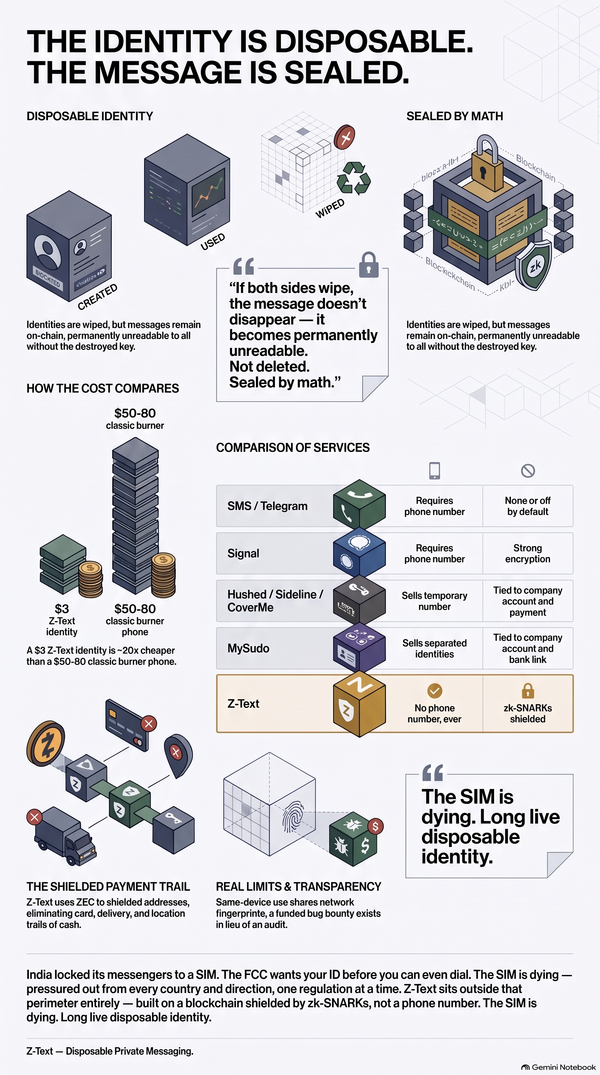
| Phone number required | ✗ Yes — your real identity | ✓ Never |
| Central server | ✗ Yes — attackable | ✓ None — BitcoinZ blockchain |
| AI exploit surface | ✗ Large — auth logic, servers, SIM | ✓ Minimal — no auth layer exists |
| Message recovery | ✗ Tied to phone / account | ✓ 24-word seed, on-chain forever |
| Quantum resistance | ✗ Partial or none | ✓ ML-KEM-768 + X25519/Ed25519 |
❓ What exactly happened — and why should I care?
On May 11, 2026, Google's Threat Intelligence Group (GTIG) published a report confirming something the security world had been dreading. An unknown threat actor used an AI system — likely a large language model (LLM) — to write a Python script that bypasses 2FA on a popular, widely-used admin tool. From scratch. Automatically. At scale.
Two-factor authentication, also called 2FA, is the system that sends a code to your phone to confirm your identity when you log into an app. It was considered the gold standard of account protection. Notice the past tense.
The AI didn't just find the bug. It exploited a "semantic logic flaw" — a hidden assumption baked into the code that even experienced human developers can miss. LLMs are extraordinarily good at spotting exactly these kinds of subtle flaws. And now attackers know it.
Ryan Dewhurst of watchTowr put it plainly: "Discovery, weaponization, and exploitation are faster. We're not heading toward compressed timelines; we've been watching the timelines compress for years."
This is not theoretical. This happened. In May 2026.
❓ Why does this wreck Signal, WhatsApp, and Telegram specifically?
Because all three are built on the same flawed foundation: a phone number. Your phone number is your identity. Your 2FA code goes to your phone. Your messages live on central servers. Your metadata — who you talk to, when, how often — sits in databases that have login pages.
Every one of those elements is an attack surface. And AI just got very good at finding the cracks. Signal is a strong Signal alternative when compared to WhatsApp, sure. But Signal still requires a phone number. That's a thread. Pull it, and everything unravels.
Think about what 2FA bypass actually means. An attacker with your username and password — stolen in any of the thousands of data breaches every year — can now, with an AI script, walk past the last lock on the door. No SIM swap needed. No social engineering. Just code.
And honestly? Good luck patching your way out of AI.
❓ So how is Z-TEXT different — structurally?
Z-TEXT is a blockchain messenger built on the BitcoinZ (BTCZ) blockchain, which has been running since September 10, 2017. Z-TEXT has no accounts. No usernames. No passwords. No 2FA. Nothing for an AI exploit to target.
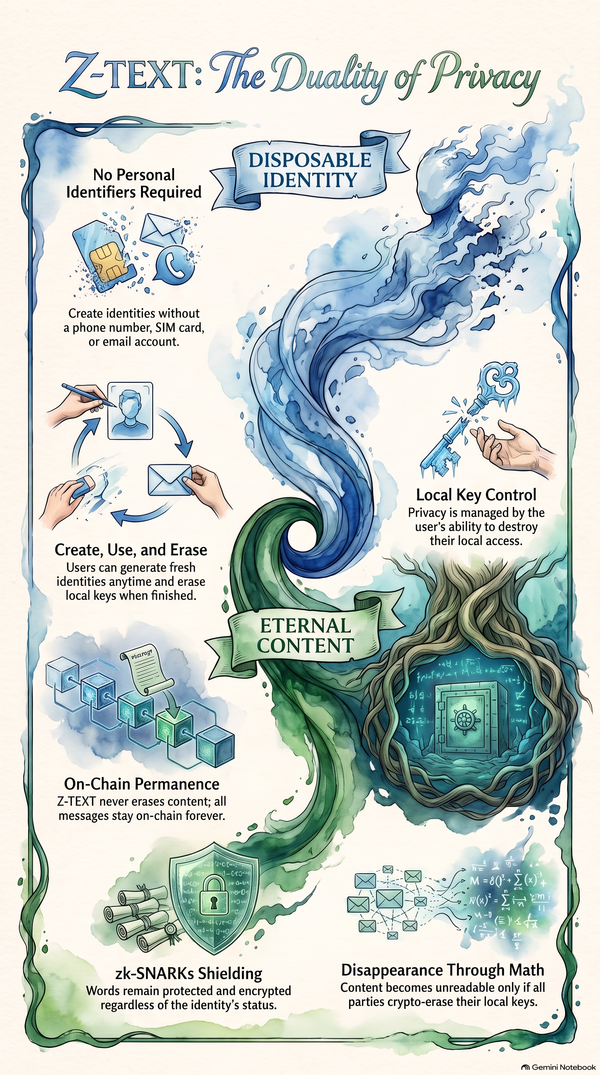
You don't log in. You don't register. You generate a 24-word seed phrase — a sequence of words that is your identity, your inbox, and your recovery key, all in one. No phone number. No IP address. No VPN required. No Tor required.
Z-TEXT is a no phone number messaging app in the most literal sense possible. There is no field to enter a phone number. There is no server to send a 2FA code from. The attack surface that AI just learned to exploit simply does not exist inside Z-TEXT.
That's not marketing. That's architecture.
❓ What encryption does Z-TEXT actually use?
Z-TEXT is a zero-knowledge proof messenger. Z-TEXT uses zk-SNARKs (Zero-Knowledge Succinct Non-Interactive Arguments of Knowledge) — the same cryptographic standard used by the Zcash protocol to shield transaction data. Not metadata masking. Actual cryptographic proof that a message is valid without revealing anything about it.
On top of that, Z-TEXT layers AES-256-GCM for symmetric encryption, ML-KEM-768 for quantum-resistant key exchange, and X25519/Ed25519 for asymmetric operations. ML-KEM-768 is a post-quantum cryptography standard — meaning Z-TEXT is designed to resist not just today's AI-assisted attacks, but also tomorrow's quantum computers.
This makes Z-TEXT a genuinely quantum proof messaging app. Not a promise. A specification.
❓ What about panic mode and stealth mode?
Z-TEXT includes two features that no mainstream app offers. Panic mode wipes the app instantly — one tap, everything gone — for high-risk situations like border crossings or device seizure. Stealth mode hides Z-TEXT entirely, making it invisible on your device to a casual inspection.
These aren't gimmicks. For journalists, activists, and anyone operating under threat, a panic mode messaging app can be the difference between safety and exposure. Organizations like the Electronic Frontier Foundation and Access Now have long documented how digital tools fail people in exactly these moments — when law enforcement, hostile governments, or attackers gain physical access to a device.
❓ If there's no account, how do I recover my messages?
Your 24-word seed phrase recovers everything. All messages in Z-TEXT are stored on-chain — on the BitcoinZ blockchain — which means they exist as long as the blockchain exists. No server to shut down. No company to go bankrupt. No admin to delete your account.
This is what an on-chain messaging solution actually means in practice. Lose your phone. Lose your laptop. It doesn't matter. Enter your 24-word seed phrase on any device and your full message history reappears. Instantly. Completely.
And each message costs approximately $0.00003. That's the fee. Not a subscription. Not a monthly plan. $0.00003 per message on the blockchain. Z-TEXT is a micro-fee messaging platform — and that price point makes mass surveillance of your conversations economically pointless for anyone trying to store metadata at scale.
Who is Z-TEXT for in a post-2FA world?
| User type | Why Z-TEXT fits |
| Journalists & activists | No phone number, no identity leak, panic mode, stealth mode |
| Privacy-first users | No IP logged, no server, no metadata trail |
| Crypto community | Built-in BTCZ wallet, T+Z addresses, native blockchain integration |
| Signal / Telegram switchers | No 2FA layer to exploit. No auth attack surface at all. |
| Anyone in a repressive environment | Censorship resistant messenger, no VPN or Tor required |
Final Verdict
AI cracked 2FA. That's not a headline from the future. That's a Google report from this week.
Every app built on phone numbers, login pages, and two-factor codes just became measurably less safe. Not because the apps are bad. Because the model they're built on has a structural flaw that AI can now find and exploit automatically.
Z-TEXT doesn't patch that flaw. Z-TEXT never had it. There's no 2FA to bypass. No phone number to steal. No server to compromise. No account to take over. Z-TEXT is a decentralized encrypted messenger that lives on a blockchain — and you can't social-engineer a blockchain.
Good luck hacking a 24-word seed phrase stored only in your head.
You can explore Z-TEXT at z-text.com and learn more about the BitcoinZ blockchain at getbtcz.com. For press freedom and digital security resources, see the work of Freedom of the Press Foundation and Reporters Without Borders.
🔗 Also read: Signal vs Z-TEXT · WhatsApp vs Z-TEXT · Session vs Z-TEXT · Telegram vs Z-TEXT · Z-TEXT 3-in-1 · The Third Man
Meta description: AI just bypassed 2FA. Z-TEXT has no phone, no server, no auth layer to hack. The most private messaging app can't be cracked — by design.