Disposable Private Messaging Without a Phone Number | Z-TEXT
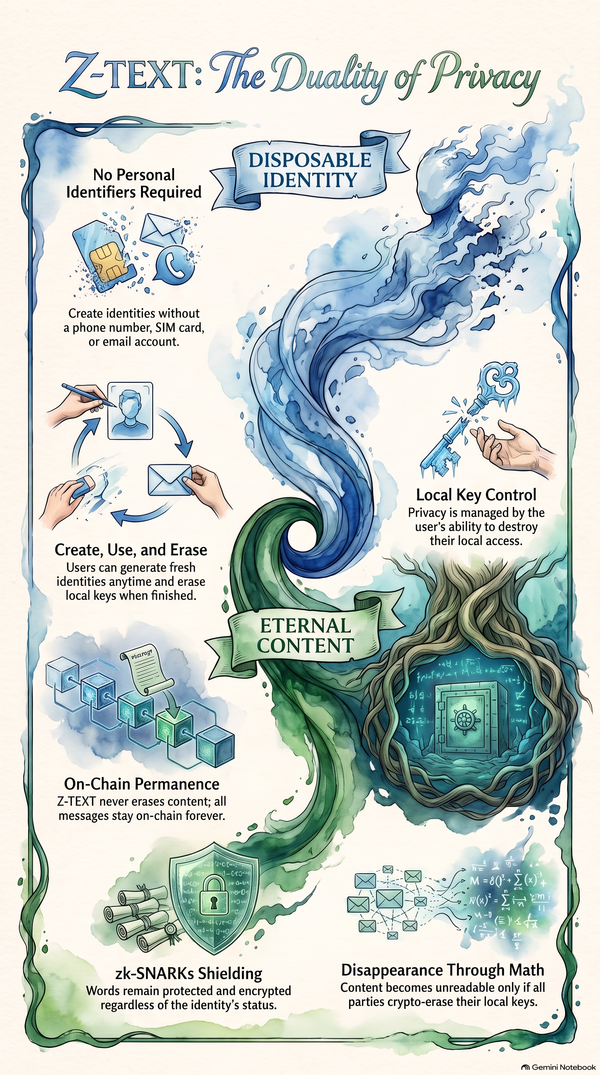
Your identity is disposable. What you say isn't — until you choose to let the key go. A first look at Z-Text's upcoming disposable private messaging identity.
A burner phone protects you only while you execute it perfectly. With Z-Text, the protection is built into the code — not up to you.
India just locked WhatsApp, Telegram, and Signal to a single SIM card. The FCC wants your government ID before you can even activate a phone line. And 55% of Americans already won't give out their real number.
Z-Text was never exposed. No SIM. No ID. No KYC. No number to leak, bind, or hand over.
What if the identity itself was disposable too?
Everything in this piece is about 1-to-1 shielded messaging — two people, fast track mode, no mnemonic.
In short:
• Z-Text lets anyone create a disposable identity for $3 — no phone number, SIM, email, or KYC
• Send a private message shielded by zk-SNARKs, destroy the key on command
• The identity is disposable. The message isn't — it stays on the blockchain permanently, readable only by whoever holds the key
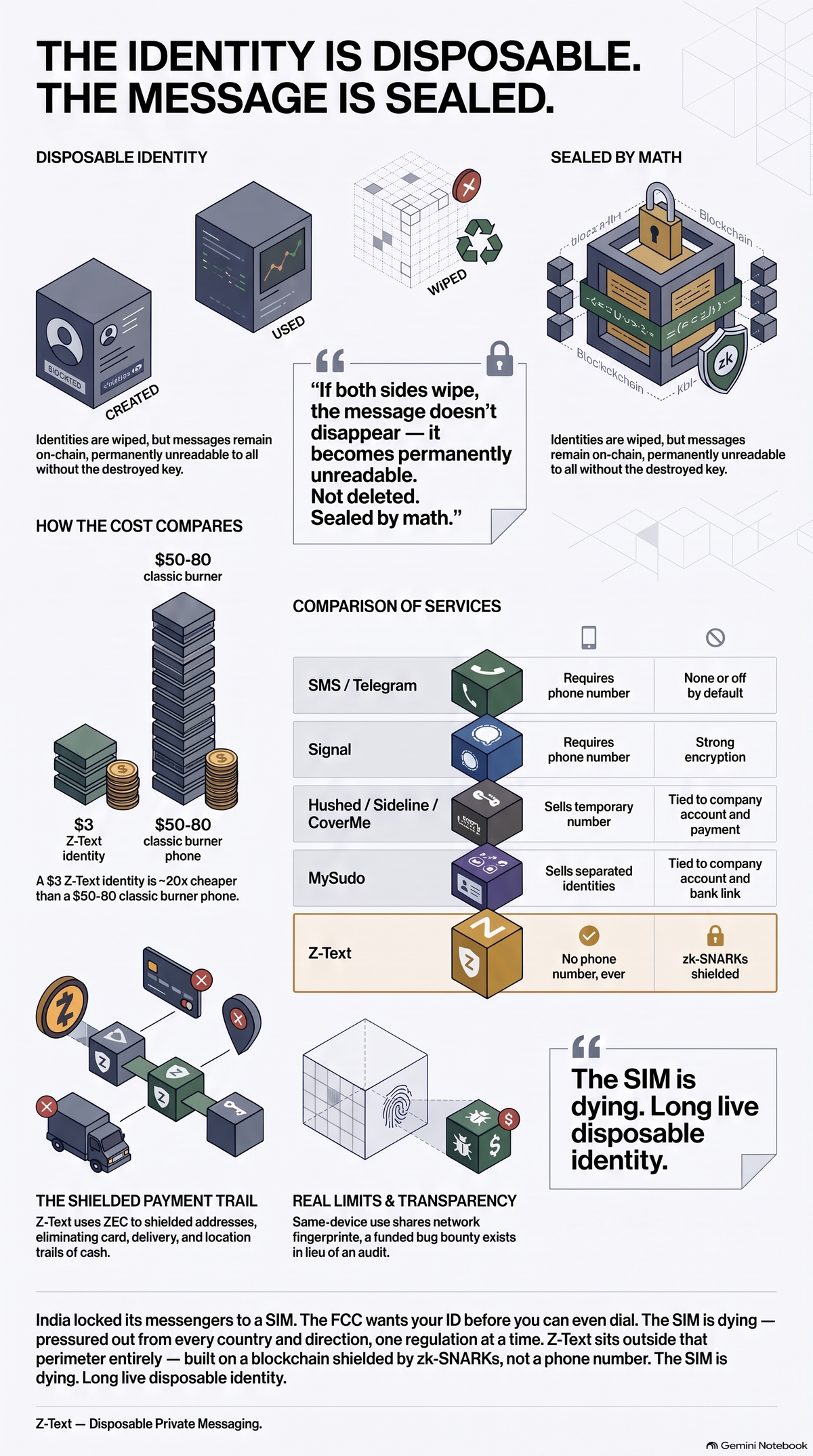
• If both sides eventually wipe, the message doesn't disappear — it becomes permanently unreadable, sealed by math instead of deleted by a company
• Roughly 20x cheaper than a burner phone, and structurally safer — no SIM, carrier, or card trail to begin with
• Against Signal: the edge isn't stronger encryption — it's no phone number, ever
• Against Hushed, Sideline, CoverMe, and MySudo: different category entirely — they sell a temporary number tied to a company account; Z-Text sells an identity tied to nothing
• Real limits exist — same-device network fingerprinting, no independent audit yet — but Tor is on by default, and a funded, on-chain bug bounty already has a verified payout
• As governments across many countries push SIM-binding, ID checks, and KYC rules onto phone-based communication, Z-Text sits outside that perimeter entirely — built on a blockchain shielded by zk-SNARKs, not a phone number
❓ 1. What does "disposable private messaging" actually mean?
It means the identity is temporary. The message isn't.
With Z-Text, anyone can create a fresh identity — no phone number, SIM, or email — send a private message, and wipe that identity when they're done. A fresh identity costs $3, requires no phone number, SIM, email, or KYC, and can be destroyed on command without touching what was actually said.
Here's the part most people get wrong at first: wiping the identity doesn't erase the message. It destroys the key that could ever read it again.
Mini-resume:
Disposable private messaging means the identity is temporary — created for one conversation, wiped when it's done — while the message itself stays exactly as private and permanent as Z-Text has always made it. A fresh identity costs $3, requires no phone number, SIM, email, or KYC.
❓ 2. How is this different from a burner phone?
A burner phone still needs a SIM. The moment it powers on, the carrier logs the IMEI, IMSI, and every tower it pings. Throw the phone in a river — the carrier's records stay.
Android adds a second layer: location comes from WiFi routers merely visible nearby, not ones it connects to. A burner doesn't even need to go online to be geolocated.
A disposable Z-Text identity skips all of it — no SIM, no IMEI, no carrier network in the path at all. That's not just cheaper. It's structurally safer: there's no carrier record to leak because there's no carrier.
Roughly 20x cheaper, and safer by design, not by discipline.
Mini-resume:
A burner phone generates a permanent carrier record the moment it powers on — IMEI, IMSI, tower logs — none of which disappears when the phone is destroyed. A disposable Z-Text identity has no SIM or carrier at all, so there's no record to create in the first place. Roughly 20x cheaper, and safer by design, not by discipline.
❓ 3. What happens when you hit the panic PIN?
The message database and the wallet are each encrypted separately, with their own 32 random bytes stored in the phone's keystore — not derived from a seed, not guessable.
The panic PIN destroys both keys, then verifies the deletion happened. What's left on the flash: encrypted blocks with no key anywhere to open them. Permanently unreadable, not wiped clean — same principle as full-disk encryption on any modern phone.
In fast-track mode, there's no seed phrase involved at all, so that risk doesn't apply here.
Mini-resume:
The panic PIN deletes both encryption keys — message database and wallet — and verifies the deletion, leaving only unreadable encrypted blocks behind. In fast-track mode there's no seed phrase to worry about, and no backup exists unless someone deliberately creates one.
❓ 4. Does wiping your identity delete what you said?
No. It deletes the key that could read it.
Z-Text never erases anything from the blockchain. What you sent stays there, permanently, sealed by zk-SNARKs. Wiping your identity doesn't touch that — it destroys your local ability to read it again.
When both sides of a conversation eventually wipe their identities, and neither ever backed up their keys, the message doesn't disappear — it becomes permanently unreadable. By anyone. Including Z-Text.
A real scenario:
A creates a disposable identity — $3. Sends a message to B. Wipes the identity immediately after.
B doesn't need to be online. Days later, B opens Z-Text, reads the message — the blockchain held it, waiting, the whole time. B wipes too.
Total cost: $6, one $3 identity each.
What's left on the blockchain: a zk-SNARKs shielded transaction, visible to nobody who doesn't hold a key that no longer exists anywhere. Not deleted. Permanently sealed.
Mini-resume:
Wiping an identity destroys the key, not the message — content stays on the blockchain forever, shielded by zk-SNARKs. When both sides of a conversation eventually wipe their keys, the message becomes permanently unreadable by anyone, including Z-Text — not through deletion, but because nothing exists anymore that can open it.
❓ 5. How does this compare to Signal, Telegram, SMS, and services like Hushed?
Not all comparisons are equal, so here's the honest version of each.
SMS
Encryption: None at protocol level
Phone number: Required
Telegram
Encryption: Off by default
Phone number: Required
Signal
Encryption: Excellent, genuinely strong
Phone number: Required to register
Hushed / Sideline / CoverMe
Product: A temporary phone number
Payment: Credit card / Apple Pay / Google Pay — name tied to the transaction
MySudo
Product: 9 separated identities (phone, email, card)
Payment: Credit card + bank account link required
Classic Burner Phone
Payment: Cash — but the store, camera, timing, and location are still a real trail
⚡ Z-Text
Encryption: zk-SNARKs shielded, no phone number ever
Price: $3 per disposable identity
Payment: ZEC to a shielded z-address — no card trail, no delivery trail
Signal's encryption is genuinely excellent — this isn't a claim to dispute. The difference is structural: Signal still needs a phone number to register. A disposable Z-Text identity never has one.
Mini-resume:
Z-Text beats SMS and Telegram outright on privacy design. Against Signal, the edge is structural — no phone number, ever — not cryptographic, since Signal's encryption is already strong. Against Hushed, Sideline, CoverMe, and MySudo, it's not really a competition — those sell temporary phone numbers or accounts tied to a company; Z-Text sells an identity that was never a phone number, and pays in shielded crypto with no card or delivery trail at all.
❓ 6. What are the real limits?
No technology removes every risk. Here's what's genuinely worth knowing.
It's mostly a hygiene question, not a flaw. Tor is on by default, hiding your IP regardless of which identity you're using. The one thing Tor doesn't touch: if you download from an app store instead of directly from z-text.com, that creates an account link between installs. Download direct, and that gap closes too.
No independent audit — yet. Nobody outside Z-Text has formally reviewed the code. What exists instead: a live, funded bug bounty — 7 ZEC, paid in crypto, with a real payout already on-chain from June 2026. Not the same as an audit. But it means real researchers are already testing it, with a paid track record anyone can check.
Mini-resume:
With Tor on by default and a direct download, Z-Text's disposable identities don't leave the network trail a phone-number app would. The honest gap is a formal audit — not yet done — though a live, funded bug bounty with a verifiable payout already on record is a real signal in the meantime.
A suggestion, not a requirement — for the maximalist.
None of this is needed to use Z-Text; the app protects you the same way regardless. But for journalists, activists, or anyone working under real threat conditions who want to close every possible gap, here's how:
1. Location off — permanently, set once
2. Airplane mode on — default resting state
3. When using Z-Text: airplane mode off, connect WiFi (different network each session)
4. Fast-track identity, message, wipe
5. Airplane mode back on when done (Location stays off throughout)
India locked its messengers to a SIM. The FCC wants your ID before you can even dial. The SIM is dying — pressured out from every country and direction, one regulation at a time.
Z-Text sits outside that perimeter entirely — built on a blockchain shielded by zk-SNARKs, not a phone number.
The SIM is dying. Long live disposable identity.
disposable private messaging · phone-number-free messenger · temporary communication identity · burner phone alternative · zk-SNARKs shielded messaging
Sources
FCC Docket 17-59/02-278 (fcc.gov) · India Department of Telecommunications SIM-binding directive · Cloaked June 2026 consumer survey · Signal transparency archive (signal.org/bigbrother)
🔗 Also read: Signal vs Z-TEXT · WhatsApp vs Z-TEXT · Session vs Z-TEXT · Telegram vs Z-TEXT · Z-TEXT 4-in-1 · The Third Man
Disposable identity. Sealed message. See how Z-Text's $3 identities work — created, used, wiped.