What's Your Messenger's LINDDUN Score?
WhatsApp, Telegram, Signal, and Facebook Messenger — scored against LINDDUN, the academic privacy framework cited in ISO 27550. None of them pass clean.

You already know your messages are encrypted. Nobody tells you what else your app knows.
LINDDUN isn't about encryption — it checks seven other ways your privacy can fail, the ones security researchers actually use, not the ones marketing pages talk about. We ran WhatsApp, Telegram, Signal, and Facebook Messenger through it. Your privacy may already be in jeopardy, along with billions of other people using the same apps.
Whole-post mini-resume: All four apps fail Identifiability — every one requires a phone number or full account, no anonymous path exists. Signal leads on Linkability and Data Disclosure thanks to sealed sender and an independently audited protocol. WhatsApp and Messenger share Meta's data-sharing ecosystem despite solid encryption. Telegram's default chats aren't end-to-end encrypted at all — only opt-in Secret Chats are. No app here is a clean sweep.
❓ 1. What is LINDDUN, in one line?
A 2011 privacy threat framework from KU Leuven, Belgium.
Cited in the ISO 27550 privacy engineering standard.
Checks seven ways privacy can fail beyond encryption.
Full framework breakdown: our first LINDDUN post.
Mini-resume: Academic, ISO-cited framework — not a marketing checklist. Applied here to the four messengers most people already have installed.
❓ 2. WhatsApp — what does LINDDUN find?
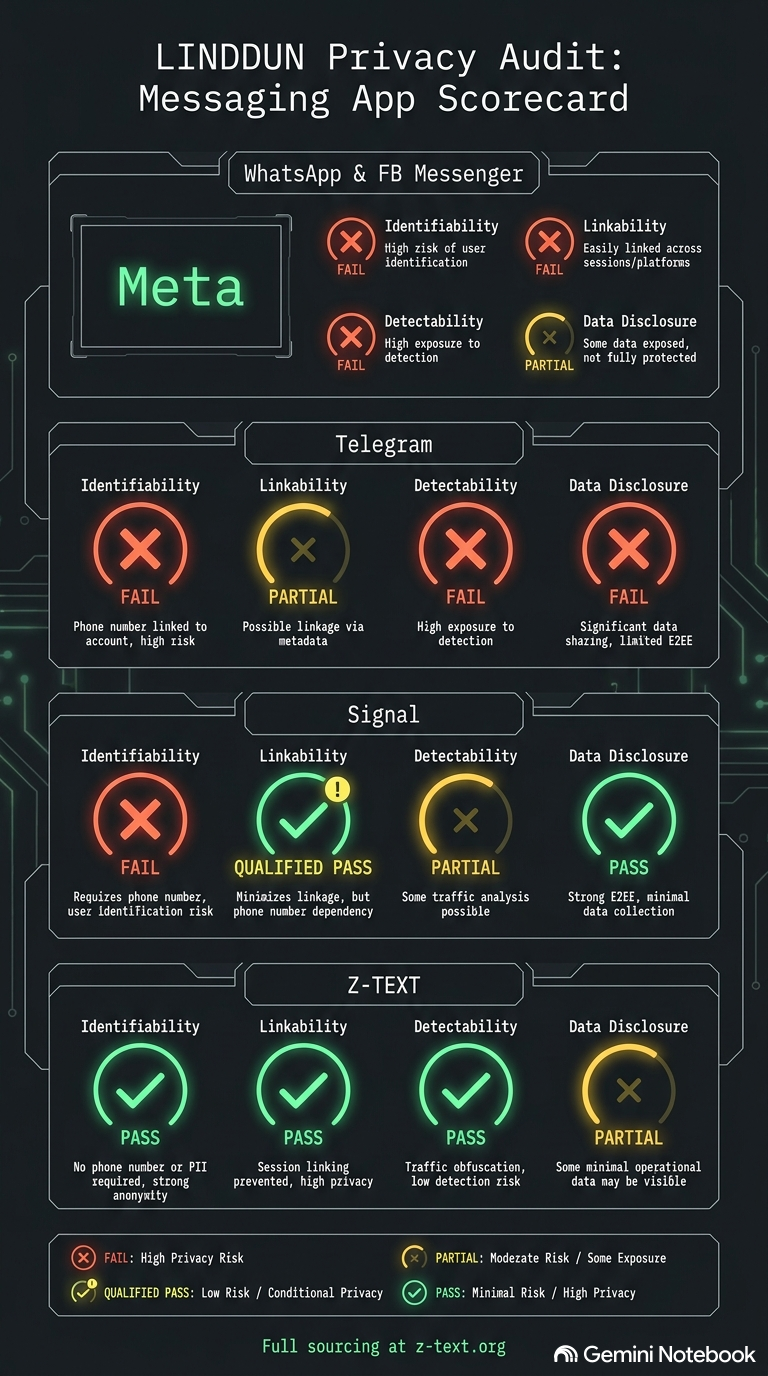
Identifiability: Fail. Phone number required at signup — no anonymous path exists.
Linkability: Fail. Contact frequency, timing, and duration are collected and retained regardless of encryption, and can be shared with Meta entities for ad personalization.
Detectability: Fail. No built-in anonymity layer (like Tor).
Data Disclosure: Partial. Uses the independently-audited Signal Protocol — solid cryptography, but a broad data-sharing footprint around it.
Mini-resume: The weak point isn't the encryption — it's everything collected around it.
❓ 3. Telegram — what does LINDDUN find?
Identifiability: Fail. Phone number required at signup.
Linkability: Partial. Default "cloud chats" retain metadata server-side; only opt-in Secret Chats avoid this.
Detectability: Fail. No built-in anonymity layer.
Data Disclosure: Fail (default chats). Cloud chats are stored encrypted but decryptable by Telegram; only device-specific Secret Chats are end-to-end encrypted and not enabled by default. One genuine positive: no ad targeting.
Mini-resume: Most users never turn on Secret Chats — so the default experience is the one that fails.
❓ 4. Signal — what does LINDDUN find?
Identifiability: Fail. Phone number required — same gap as the rest.
Linkability: Qualified pass. "Sealed sender" strips identifying info from the outside of the encrypted envelope — the strongest result of the four here, though it rests on trusting Signal's account of its own, not-fully-open-source servers.
Detectability: Partial. Protection specifically at the server-routing level.
Data Disclosure: Pass. Protocol independently audited by academic researchers, non-profit, no ad model.
Mini-resume: Strongest of the four on architecture — but the phone-number requirement is the same gap everyone shares.
❓ 5. Facebook Messenger — what does LINDDUN find?
Identifiability: Fail. Tied to a full Meta/Facebook account — a bigger identity footprint than a phone number alone.
Linkability: Fail. Same Meta ecosystem data-sharing as WhatsApp.
Detectability: Fail. No built-in anonymity layer.
Data Disclosure: Partial. End-to-end encryption became default for personal chats and calls in December 2023 — a genuine improvement — but still sits inside Meta's broader data-sharing ecosystem.
Mini-resume: A real 2023 upgrade, still inside the same ecosystem exposure as WhatsApp.
❓ 6. Full scorecard
Identifiability Fail
Linkability Fail
Detectability Fail
Data Disclosure Partial
Telegram
Identifiability Fail
Linkability Partial
Detectability Fail
Data Disclosure Fail
Signal
Identifiability Fail
Linkability Qualified Pass
Detectability Partial
Data Disclosure Pass
Facebook Messenger
Identifiability Fail
Linkability Fail
Detectability Fail
Data Disclosure Partial
Non-repudiation, Unawareness, and Non-compliance are not evaluated in this pass.
Mini-resume: No app here is a clean sweep. Signal leads on privacy architecture but shares the same phone-number gap as the rest. Telegram's biggest weakness is that its default experience — the one most users never change — isn't end-to-end encrypted at all.
Sources
LINDDUN framework: linddun.org (KU Leuven, cited in ISO 27550)
WhatsApp Privacy Policy: whatsapp.com/legal/privacy-policy
Telegram official FAQ, Secret Chats: telegram.org/faq
Signal Protocol academic security audit: pindrop.com
Meta, "Launching Default End-to-End Encryption on Messenger" (Dec 7, 2023): about.fb.com
🔗 Also read: Signal vs Z-TEXT · WhatsApp vs Z-TEXT · Session vs Z-TEXT · Telegram vs Z-TEXT · LINDDUN Score: Z-TEXT vs 7 Ultra-Privacy Messengers
LINDDUN score messenger · private messaging app · secure messenger · zero-knowledge proof messenger