No Phone. No KYC. Zero Metadata. This Is Z-TEXT.
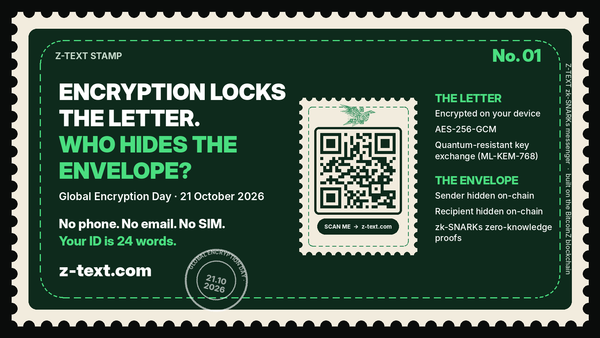
Z-TEXT never asks for a phone number, ID, or KYC. Built on zk-SNARKs zero-knowledge proofs, it's a messenger with zero metadata by design.
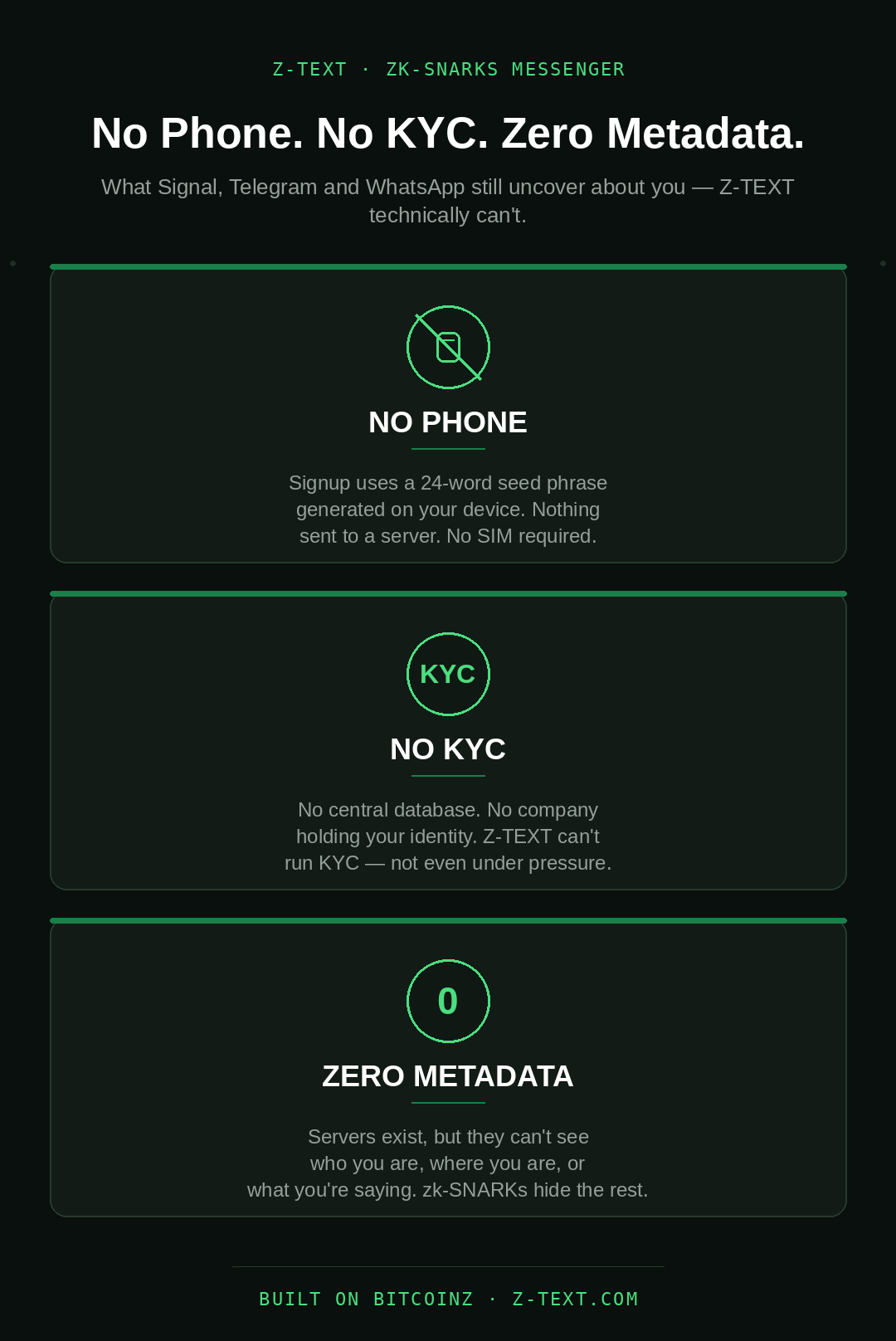
What Signal, Telegram and WhatsApp still uncover about you — Z-TEXT technically can't.
Z-TEXT is a messenger that technically cannot ask for your phone number, your ID, or your identity — because none of that exists in its architecture.
No phone. No KYC. No metadata.
While Signal, Telegram, and WhatsApp still collect who you talk to and when, Z-TEXT is built on zk-SNARKs zero-knowledge proofs so there's nothing left to resell.
❓ 1. Does Z-TEXT require a phone number to sign up?
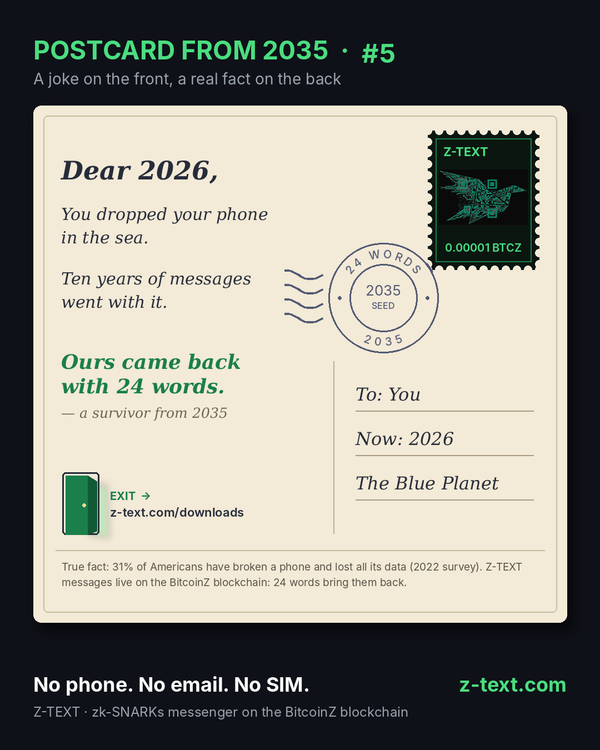
No. Z-TEXT never asks for a phone number. Signup uses a 24-word seed phrase generated locally on your device.
Nothing is sent to a server, nothing is tied to a SIM card.
Compare that to Signal, Telegram, and WhatsApp, which all still require a phone number at registration, even with usernames layered on top.
❓ 2. What is KYC — and why does Z-TEXT never ask for it?
KYC stands for "Know Your Customer" — the ID check banks and exchanges require. Z-TEXT isn't a broker and doesn't sell crypto.
The built-in BTCZ wallet is non-custodial, and BTCZ inside the app is fuel for sending messages — not a product Z-TEXT trades.
There's no central database, no company holding your identity. Your 24-word seed phrase, generated on your device, is your identity.
Z-TEXT doesn't run KYC, because the architecture never collects an identity to hand over in the first place.
❓ 3. Can a messenger be encrypted but still leak who you talk to?
Yes. Encryption protects message content — nobody can read what you wrote.
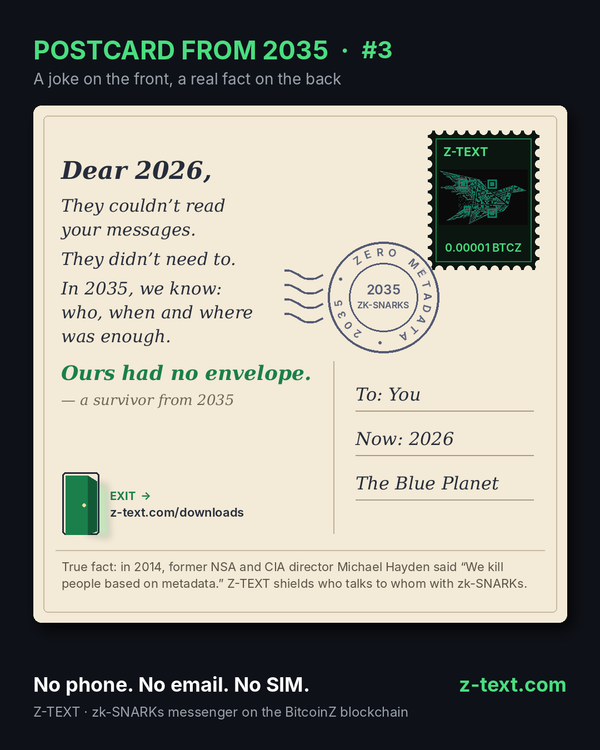
But it doesn't hide metadata: who messaged whom, when, how often. A server can encrypt every message perfectly and still see your entire social graph.
Metadata alone can expose relationships and identity, even when content stays fully encrypted.
❓ 4. What's the magic behind zk-SNARKs?
Cryptographers call zk-SNARK math "moon math" — because it looks and feels like magic, even though it's pure mathematics.
In plain terms: it lets you prove something is true, without showing any of the information inside it. Simple example: proving you know a password, without ever revealing the password itself.
Z-TEXT uses zk-SNARKs to prove a message or transaction is valid — without revealing the sender, the receiver, or the content.
Combined with AES-256-GCM encryption on top, this is what makes Z-TEXT's metadata invisible, not just the message text.
Anybody trying to spy on the network — even Z-TEXT itself — can't see what's going on.
❓ 5. Why is Z-TEXT zero metadata?
Z-TEXT does use servers — its own lightwalletd nodes — but they can't see who you are, where you are, or what you're saying.
No phone number tied to your account. No email. No central database of contacts.
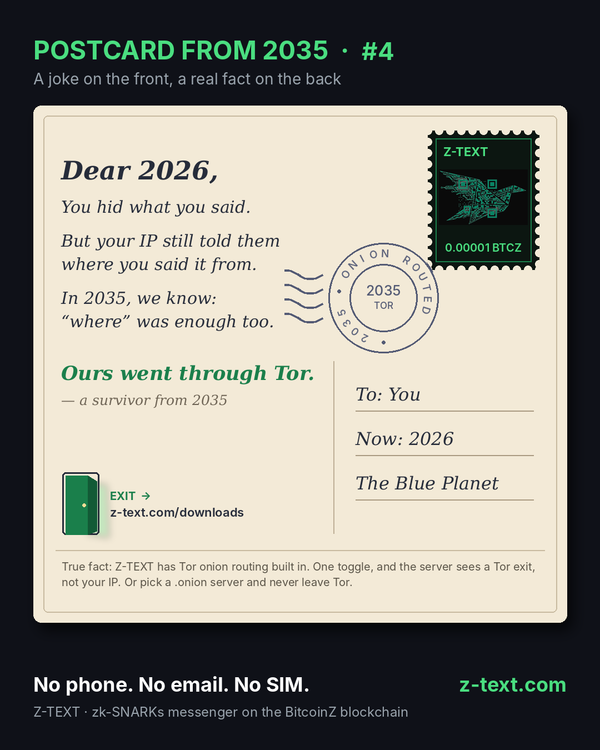
Messages route through built-in Tor, so your IP stays hidden. And zk-SNARKs prove your messages are valid without revealing who sent them, who received them, or what was said.
Take away identity, take away IP exposure, take away content — and there's no metadata trail left to collect, store, or hand over.
❓ 6. What is Z-TEXT?
Z-TEXT is a 4-in-1 privacy app built on BitcoinZ (BTCZ): a shielded messenger, a password manager, a crypto wallet, and Channels for broadcast.
One app, one seed phrase, no separate accounts for each tool.
Every connection routes through built-in Tor, no setup needed — your IP stays hidden by default.
On top of that, Z-TEXT layers three types of encryption: zk-SNARKs for content privacy, classical X25519/Ed25519 key exchange, and an optional post-quantum layer (ML-KEM-768) you can activate per chat.
Z-TEXT's 1-year plan is $36 — no phone, no KYC, no metadata, from day one.
Full pricing and license codes are at z-text.com/packages.
Sources: Wikipedia — Zero-Knowledge Proof · Wikipedia — Know Your Customer
no phone number messenger · zero metadata messenger · zk-SNARKs zero-knowledge proof messenger · no KYC messenger
How Z-TEXT's architecture removes the database — so there's no identity left to look up.