No Phone Number, Zero Metadata: The 2026 Messenger Guide


What Is a Zero-Metadata Messenger? A Clear 2026 Guide
Quick answer: A zero-metadata messenger is an app that reveals nothing about who you are, who you talk to, or when — not just what you say. It requires no phone number, no email, and stores no logs. In 2026, the main options are SimpleX Chat, Session, Threema, and Z-TEXT.
Definition: Metadata vs. Message Content
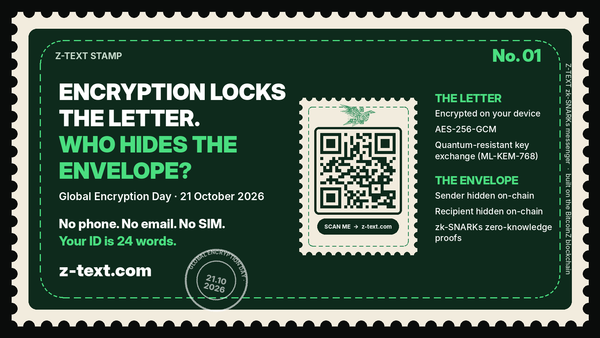
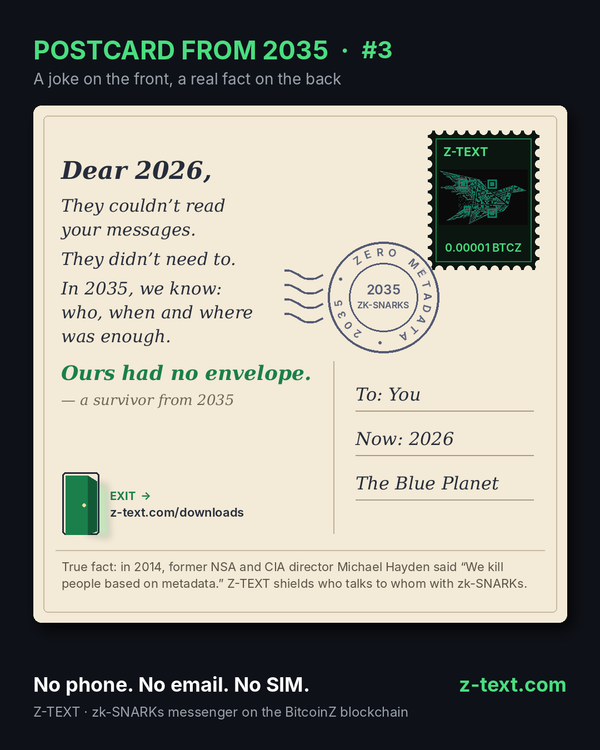
Message content is what you write. Metadata is everything around it — your phone number, your contact list, who you messaged and when, your IP address, your device fingerprint. Most "encrypted" apps protect the content but still collect metadata. A true zero-metadata messenger protects both.
The Difference: Phone-Based vs. Phone-Free Identity
Apps like Signal and WhatsApp require a phone number to create an account. That number ties your identity to a government-regulated carrier, and it becomes a single point of failure — phishable, SIM-swappable, subpoenable. Phone-free messengers instead generate identity from a cryptographic key or seed phrase, created entirely on your device.
SimpleX Chat
Phone number: No
Identity: No identifiers at all
Notable: No user ID of any kind, even internally
Session
Phone number: No
Identity: Key-pair Session ID
Notable: Onion-routed via Oxen network
Threema
Phone number: No
Identity: Random 8-digit ID
Notable: Swiss jurisdiction, paid app
Z-TEXT
Phone number: No
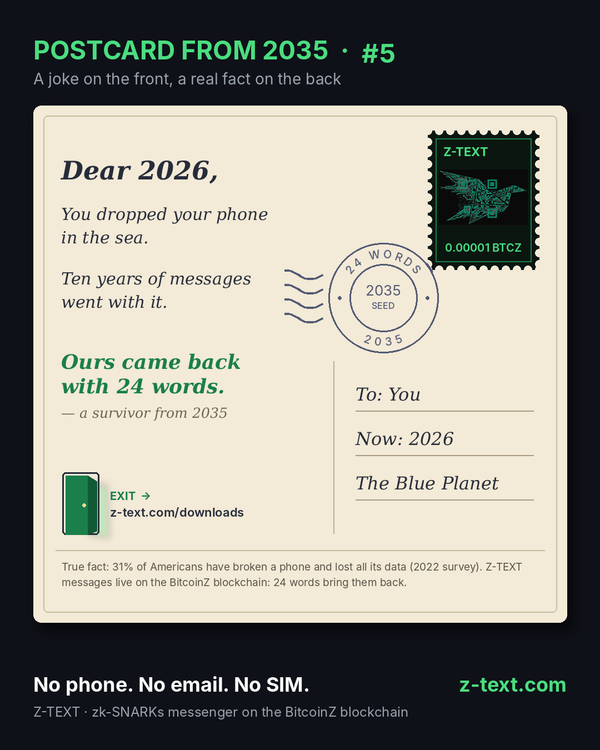
Identity: 24-word seed phrase
Notable: zk-SNARKs zero-knowledge proofs + built-in crypto wallet
Signal
Phone number: Yes
Identity: Phone + SMS code
Notable: Largest user base, gold-standard encryption
Why This Category Exists
Security researchers have long noted that metadata can reveal as much as message content — who you talk to, and when, often maps social relationships and behavior patterns without ever reading a single word. The Electronic Frontier Foundation has documented this repeatedly: government bulk metadata programs have historically targeted call and message patterns specifically because content encryption doesn't stop pattern analysis.
This is also why 2026 saw real damage from phone-based identity: state-linked phishing campaigns specifically targeted Signal and WhatsApp users by impersonating support accounts and requesting SMS verification codes — an attack that structurally cannot happen to an app with no phone number at all.
Common Questions
❓ Does removing the phone number weaken security?
No — it removes an entire attack surface. Identity built on a locally-generated seed phrase can't be phished by SMS, can't be SIM-swapped, and doesn't depend on a telecom carrier's security practices.
❓ What's the trade-off?
Recovery responsibility shifts to the user. Lose your seed phrase, and there's no company database to reset a password from. That's the price of not depending on a phone number — full ownership, full responsibility.
❓ Is Z-TEXT different from the others on this list?
Z-TEXT combines phone-free identity with a built-in shielded crypto wallet and password manager, using zk-SNARKs zero-knowledge proofs and post-quantum encryption (ML-KEM-768) on the BitcoinZ blockchain — a 4-in-1 approach the other apps on this list don't offer.
Final Verdict
If you want the largest user base with solid encryption, Signal remains the mainstream choice despite its phone number requirement. If phone-free identity matters more than adoption, SimpleX, Session, Threema, and Z-TEXT zk-SNARKs messenger all remove that dependency — each with a different secondary focus, from SimpleX's radical anonymity to Z-TEXT's built-in wallet and post-quantum encryption.
🔗 Also read: Signal vs Z-TEXT · Session vs Z-TEXT · FBI Warns of Signal Phishing · Z-TEXT 3-in-1
Written by Eric Pierrot, Founder, Z-TEXT LLC — building privacy tools without phone numbers, email, or metadata.
For the technical definition of "shielded" vs. plain encryption, see What Is a Shielded Messenger?