The Private Messenger That's Actually Simple
Every messenger arbitrages privacy against ease. zk-SNARKs don't — here's how Z-TEXT closes the gap Signal and SimpleX left open.
What is Z-TEXT?
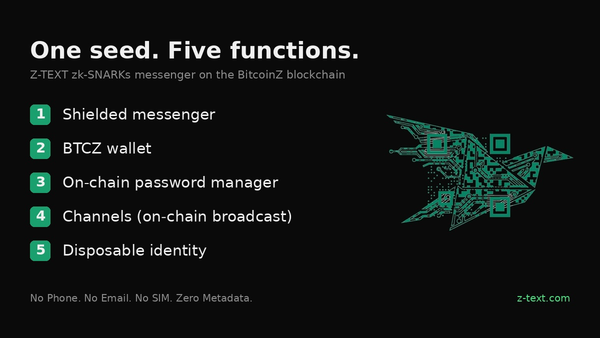
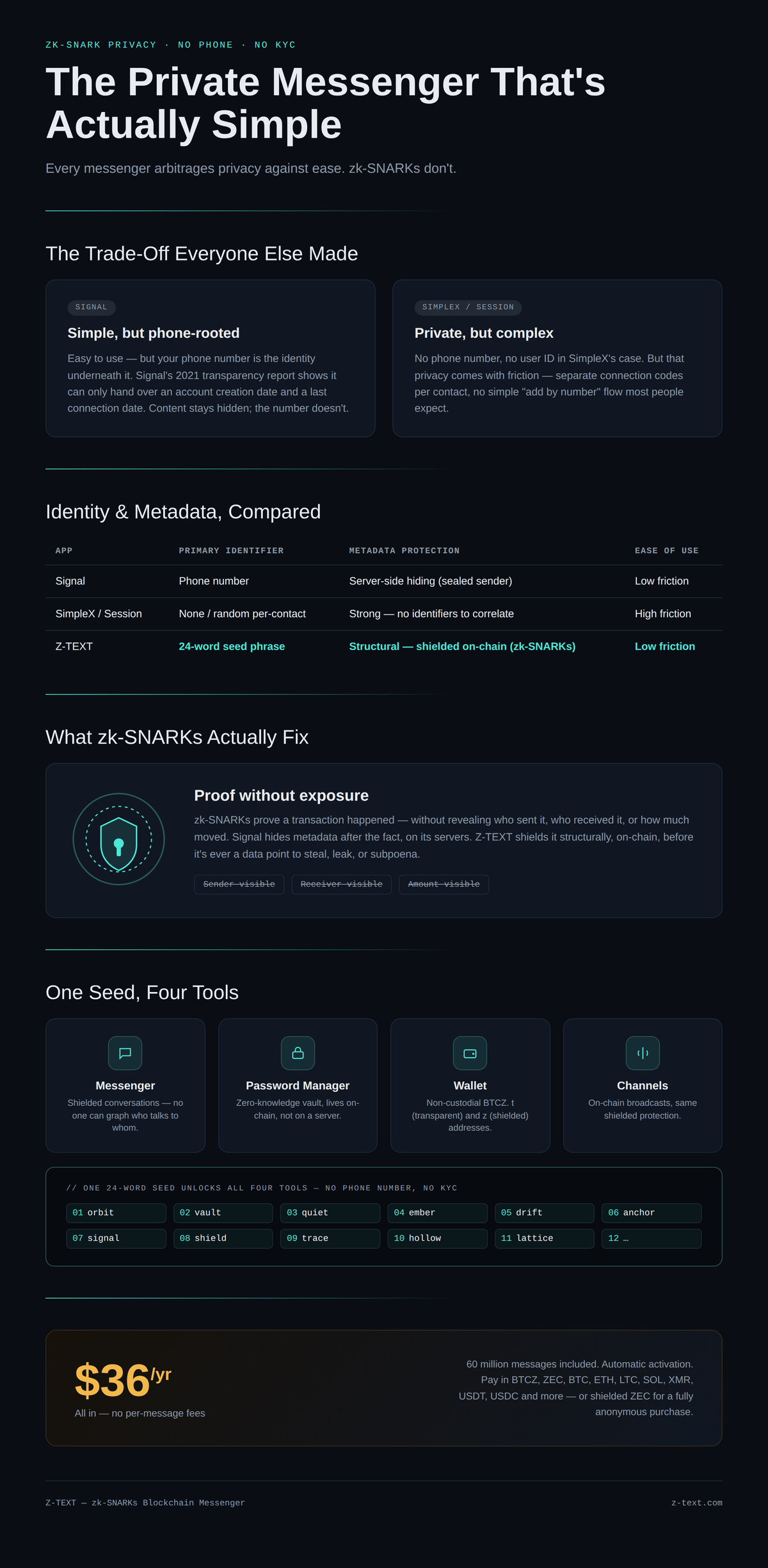
Z-TEXT is a zk-SNARKs blockchain messenger. It requires no phone number, no email, no SIM. Z-TEXT combines a shielded messenger, a password manager, a non-custodial BTCZ wallet, and on-chain Channels in one app — unlocked by a single 24-word seed.
Why does every private messenger make you choose between privacy and ease?
Signal is easy — install it, use your phone number, message anyone. But that phone number is the one thing tying your identity to your real self. SimpleX and Session go further: no phone number, no user ID at all in SimpleX's case. But that privacy comes with friction — separate connection codes per contact, no simple "add by number" flow most people expect.
Every messenger on the market has made this trade. Simple and traceable, or private and complicated. Nobody has closed both ends at once.
Can Signal really not be subpoenaed?
Mostly true. Signal's 2021 subpoena response proves it: asked for a user's name, address, correspondence, contacts, could only hand over two things — account creation date, last connection date. Content encryption works.
But metadata is the real fight. Signal recently started rolling out phone-number-free accounts, closing the SIM-swap gap. Yet as Ethereum's Vitalik Buterin noted on August 7, message timing and contact-graph patterns can still identify users even without a phone number. Removing the number moves you from identified to pseudonymous — not invisible.
Is there anything more private and simpler than Signal?
More private — yes. SimpleX Chat uses no user IDs at all, not even random ones. Session and Threema also skip the phone number entirely.
Simpler — no. Every one of them trades ease for that privacy. SimpleX's no-identifier model means separate connection codes per contact, no simple "add by number."
That trade-off is the same one Apple spent decades proving wrong. Apple didn't win by having more features — it won by removing friction until the product just worked. Nobody's done that for privacy yet.
What do zk-SNARKs actually fix?
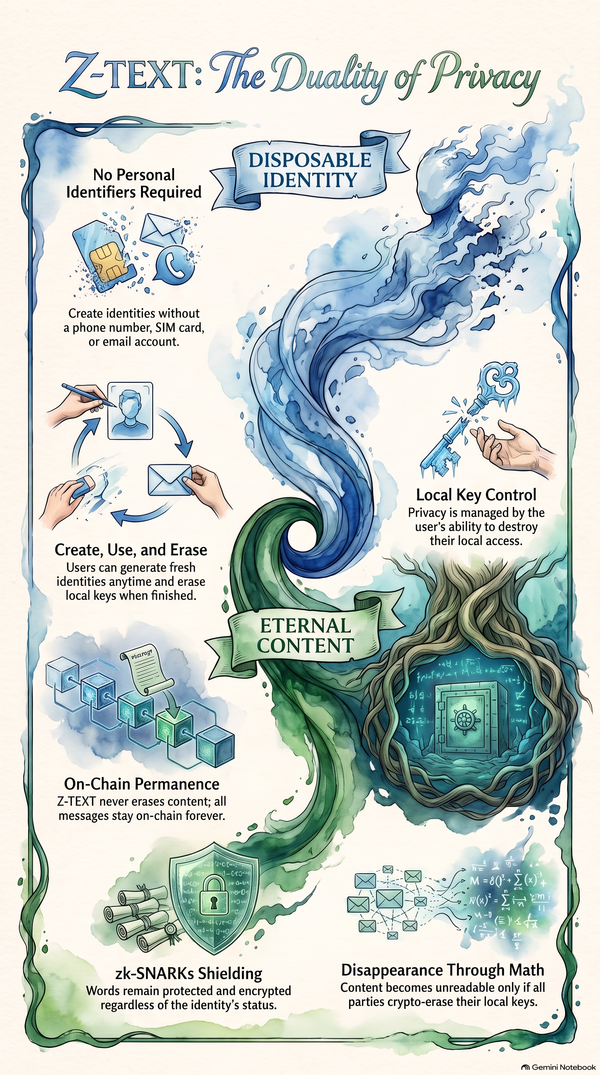
zk-SNARKs are the "moon math" — cryptography so advanced it can prove a transaction happened without revealing who sent it, who received it, or how much moved. No identity graph. Not hidden. Never created.
Signal hides metadata after the fact, server-side. zk-SNARKs shield it structurally, on-chain, before it's ever a data point to steal, leak, or subpoena.
What's actually included in Z-TEXT?
Four tools, one seed:
- Messenger — shielded conversations, no one can graph who talks to whom.
- Password manager — zero-knowledge vault, lives on-chain, not on a server.
- Wallet — non-custodial BTCZ, your keys only. Two address types: t (transparent) and z (shielded).
- Channels — on-chain broadcasts, same shielded protection.
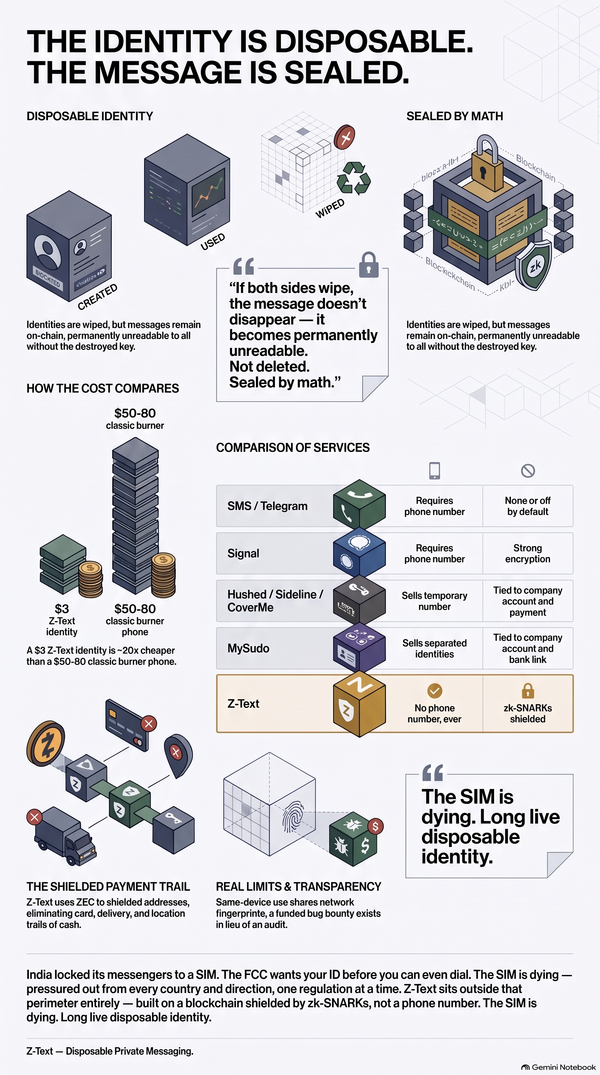
No phone number. No KYC. No trace, because zk-SNARKs never let one form.
How much does it cost, and how do you start?
1-year license: $36. All in — no per-message fees, no hidden charges. 60 million messages included, automatic activation. Pay in BTCZ, ZEC, BTC, ETH, LTC, SOL, XMR, USDT, USDC, and more, or with shielded ZEC for a fully anonymous purchase.
To start: download the app, create your wallet, write down your 24-word seed phrase, add a contact by their z-address, send. First message lands in 1–5 seconds.
Sources:
Signal Transparency Reports — https://signal.org/bigbrother/
z-text.com — Packages — https://z-text.com/packages
Electric Coin Company — What are zk-SNARKs? — https://z.cash/learn/what-are-zk-snarks/
2.5-minute breakdown: the privacy-simplicity trade-off, and how zk-SNARKs close it.