Your Phone Died. Did Your Messages Die Too?
Peer-to-peer or on-chain? When your phone dies, one keeps your chats, one loses them. Z-TEXT brings them back with 24 words.

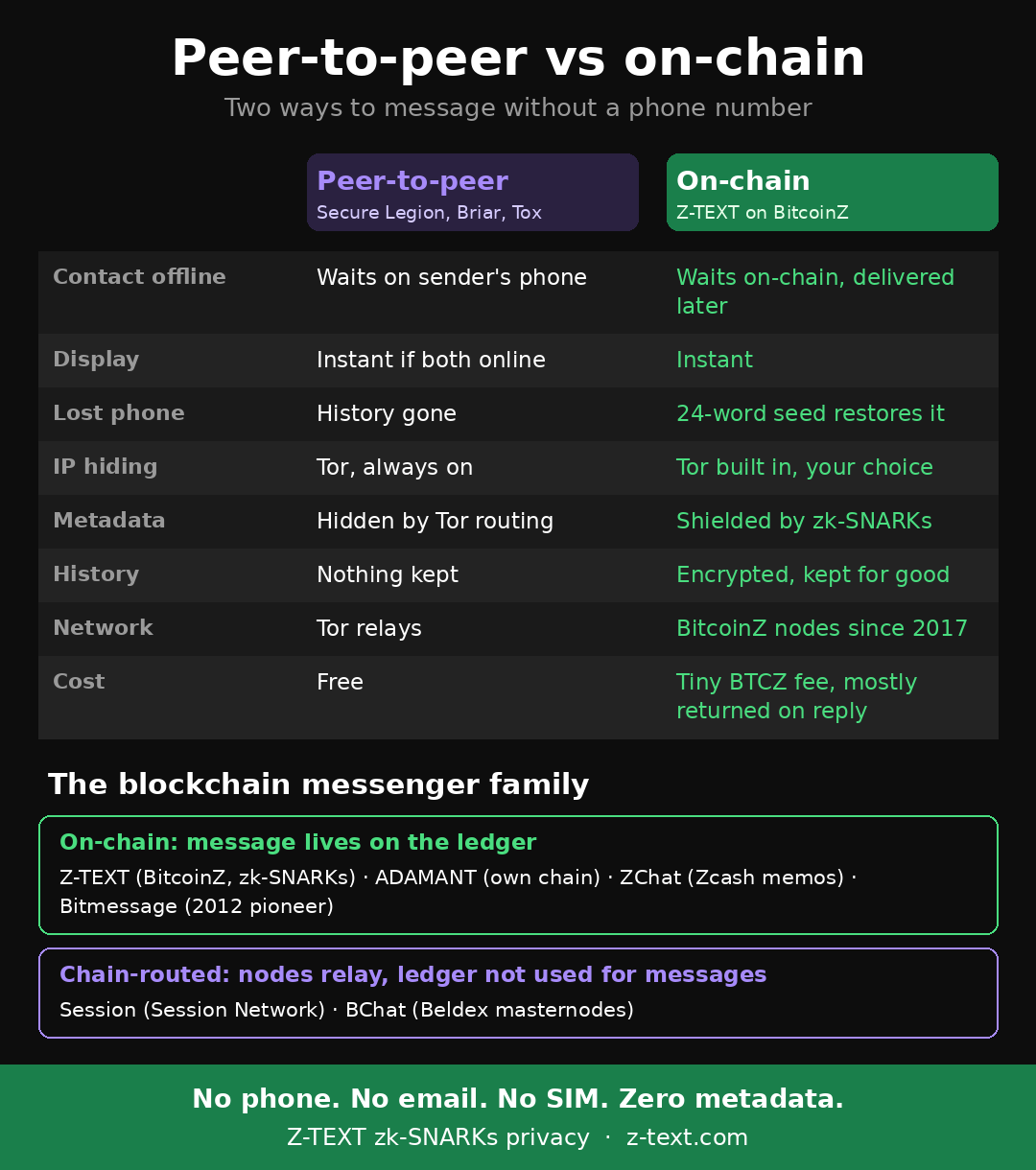
Peer-to-peer or on-chain? Two ways to message without a phone number, and only one of them brings your chats back when your phone is gone.
Your phone falls in a lake. Or it gets stolen on the train. It happens to everyone, sooner or later. Z-TEXT is a private messenger on the BitcoinZ blockchain with no phone number, no email and no SIM. And this post is about one simple question: when your phone dies, do your messages die with it?
Meet two friends. Anna uses a peer-to-peer messenger. Ben uses Z-TEXT. Both lose their phone on the same day. Anna buys a new phone, opens her app, and finds an empty screen. Years of chats, gone. Ben buys a new phone, installs Z-TEXT, types his 24 words, and watches his conversations come back.
Same bad day. Two very different endings.
Mini-resume
Private messengers without a phone number come in families. Peer-to-peer messengers, like Secure Legion, Briar and Tox, send messages straight from phone to phone, so your history lives only on your devices. On-chain messengers, like Z-TEXT and ADAMANT, write the encrypted message onto a blockchain, so it can be recovered on a new phone. Z-TEXT adds zk-SNARKs privacy and restores everything from one 24-word seed. Researchers have long noted that decentralized messengers face either sync problems or scaling problems.
❓ 1. Where do your messages actually live?
Every messenger keeps your messages somewhere. There are three main places.
On a company's servers. WhatsApp, Telegram and Signal pass your messages through servers the company runs. You need an account, and usually a phone number.
Only on your phone. Peer-to-peer messengers skip the server. The message travels from your phone to your friend's phone. Your history lives on your devices, and nowhere else.
On a blockchain. On-chain messengers write each encrypted message onto a public ledger, shared by thousands of computers. Z-TEXT works this way, on the BitcoinZ blockchain, which has run since September 10, 2017.
Mini-resume
Messages live in one of three places: a company's servers (WhatsApp, Telegram, Signal), only on your own phone (peer-to-peer messengers), or on a blockchain (on-chain messengers like Z-TEXT). Where your messages live decides what happens when you lose your phone.
❓ 2. What is a peer-to-peer messenger?
A peer-to-peer messenger connects two phones directly, with no company server in between. Secure Legion, Briar and Tox are examples.
Secure Legion is a good recent case. It sends messages fully peer-to-peer through Tor hidden services, and uses a Solana wallet keypair instead of a phone number.
That design has a real strength: there's no message server to watch. But it has a cost. If your friend is offline, the message waits on your phone until they come back online. Both phones have to be online at the same time. And your history sits on your phone, so a lost phone can mean lost chats.
Mini-resume
A peer-to-peer messenger sends messages straight from phone to phone, often through Tor, with no company server in the middle. Secure Legion, Briar and Tox work this way. The trade-off: both phones must be online to deliver a message, and the history lives on your devices.
❓ 3. What is an on-chain messenger?
An on-chain messenger writes the encrypted message into a blockchain transaction. The message doesn't need your friend to be online. It waits on the chain, and their app picks it up when they open it.
Z-TEXT isn't alone here, and that's a good sign for the idea. ADAMANT says all its messages are stored directly in its blockchain. ZChat sends messages as encrypted Zcash memos. The pioneer was Bitmessage in 2012, which, according to ADAMANT, struggled with slow delivery, heavy CPU use and no mobile apps.
Fourteen years later, on-chain messages show up instantly in Z-TEXT. The blockchain does the remembering in the background.
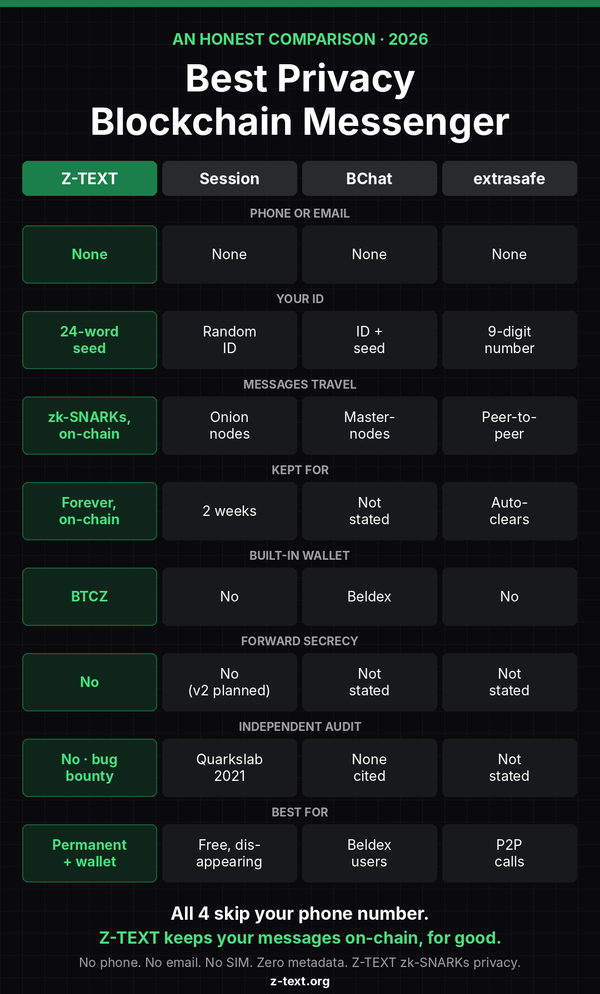
One honest note. Some messengers use a blockchain network without storing messages on it. Session routes messages through its own Session Network, and BChat through Beldex masternodes. We call those "chain-routed", not on-chain.
Mini-resume
An on-chain messenger stores each encrypted message in a blockchain transaction, so the message waits for an offline contact and can be recovered later. Z-TEXT (BitcoinZ), ADAMANT (its own chain) and ZChat (Zcash memos) are on-chain; Bitmessage tried it first in 2012. Session and BChat use blockchain networks to route messages, but don't keep them on a ledger.
❓ 4. What do researchers say?
This isn't just marketing talk. Security researchers have studied it.
The classic review, "SoK: Secure Messaging", presented at the 2015 IEEE Symposium on Security and Privacy, found that decentralized messaging designs "either exhibit synchronicity issues or have serious scalability problems." In plain words: phone-to-phone apps struggle when people aren't online at the same time, and the alternatives struggle to grow.
A newer survey, "SoK: Metadata-Protecting Communication Systems" (University of Waterloo, PoPETs 2024), reviewed 31 systems built to hide who talks to whom. It calls private messaging between people who aren't online at the same time under-researched. It doesn't cover blockchains, so we won't pretend it backs Z-TEXT. But it shows the gap is real.
Mini-resume
The 2015 IEEE study "SoK: Secure Messaging" found that decentralized messengers face either sync problems or scaling problems. The 2024 PoPETs survey of 31 metadata-protecting systems calls private messaging between offline users under-researched. Peer-to-peer apps hit the sync problem; on-chain apps like Z-TEXT pay with small fees and block space instead.
❓ 5. Peer-to-peer vs on-chain: how do they compare?
My take? Neither design is "wrong". If you want nothing stored anywhere, peer-to-peer fits. If you want your words to survive a broken phone, on-chain wins.
Mini-resume
Peer-to-peer messengers are free and store nothing off your devices, but need both phones online and keep history only on your phone. Z-TEXT delivers to offline contacts, shows messages instantly, shields metadata with zk-SNARKs, offers built-in Tor, and restores history from a 24-word seed, for a tiny BTCZ fee per message.
❓ 6. How does Z-TEXT bring your messages back?
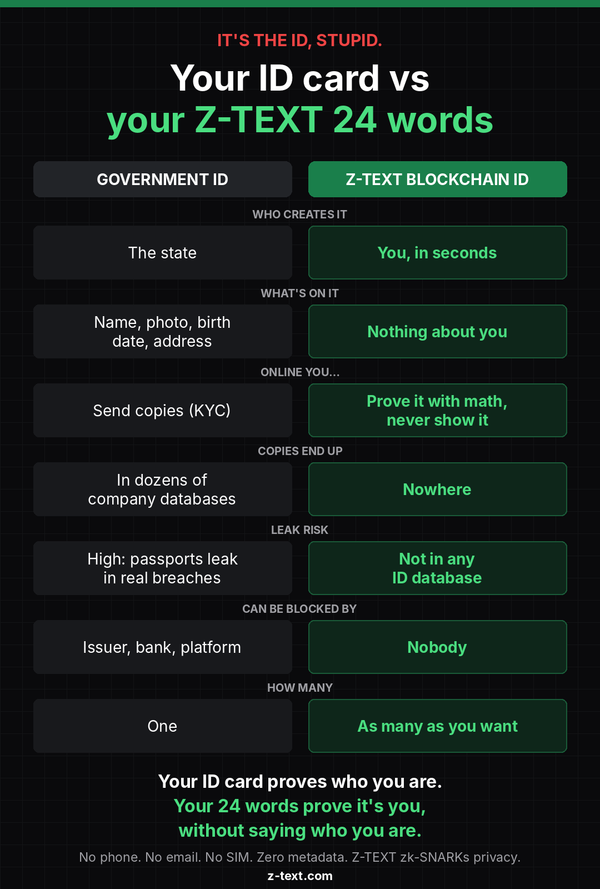
With 24 words. When you create a Z-TEXT wallet, the app shows you a 24-word seed phrase, made on your phone. That seed is your identity. No phone number. No email. No account at a company.
Z-TEXT puts five tools under a single 24-word recovery seed: messenger, password manager, wallet, Channels and disposable identities.
Lose your phone? Install Z-TEXT on a new one and type your 24 words. Z-TEXT reads the BitcoinZ blockchain again and brings back your messages, contacts, passwords and wallet.
Privacy stays on while the blockchain remembers. Each Z-TEXT message is a shielded transaction. zk-SNARKs, zero-knowledge proofs that confirm a transaction is valid without revealing it, hide the sender, the recipient and the content. The blockchain remembers. Z-TEXT never tells.
And honestly? This is why we built Z-TEXT. Disappearing chats sound safe, but if an app has to delete your words to protect them, it's admitting it couldn't protect them.
Mini-resume
Z-TEXT restores your history from a 24-word seed phrase made on your phone. On a new device, Z-TEXT rescans the BitcoinZ blockchain and brings back messages, contacts, passwords and wallet balance. zk-SNARKs keep sender, recipient and content shielded, so the blockchain remembers without telling.
❓ 7. What are the honest limits?
Every design has a price. Here's Z-TEXT's.
Your 24 words are everything. Lose them and nobody can recover your account, not even us. Write them on paper and keep them safe.
A small fee per message. Each message costs at most 0.0002 BTCZ. Most of it goes to the recipient and comes back when they reply.
An encrypted copy is kept for good. That's the point of Eternal Memory, but it also means the encryption has to last. Z-TEXT one-to-one messages use a hybrid key exchange with ML-KEM-768, a post-quantum algorithm. Signatures still use classical Ed25519, so Z-TEXT is quantum-resistant, with more post-quantum work still ahead.
Tor is off until you turn it on. Z-TEXT has a built-in Tor client, no extra app needed. Turn it on if you want to hide your IP address.
No independent audit yet. But an active, on-chain bug bounty, paid in ZEC from a pool anyone can check on-chain, invites researchers to test it.
Text, not photos. Z-TEXT sends text, links, stickers and emoji, not photos, videos or heavy files.
Mini-resume
Z-TEXT's limits: losing the 24-word seed means losing the account; each message costs at most 0.0002 BTCZ, mostly returned on reply; an encrypted copy is kept permanently, protected by a hybrid post-quantum key exchange; Tor must be switched on; there's no independent audit yet, only an active bug bounty paid in ZEC; and Z-TEXT sends text, links, stickers and emoji, not photos or video.
❓ 8. So, which one should you choose?
Ask yourself one question. If your phone dies tomorrow, do you want your messages back?
If the answer is no, and you'd rather nothing exists anywhere, a peer-to-peer messenger like Briar or Secure Legion is a fair choice.
If the answer is yes, you want an on-chain messenger. And if you also want metadata shielded by zk-SNARKs, a wallet, a password manager, Channels and disposable identities in the same app, that's Z-TEXT.
Your phone will die one day. Your words don't have to.
Mini-resume
Choose a peer-to-peer messenger if you want nothing stored off your devices. Choose an on-chain messenger if you want your history to survive a lost phone. Z-TEXT is an on-chain messenger on BitcoinZ with zk-SNARKs privacy, no phone number, and five tools in one app.
No phone. No email. No SIM. Zero metadata. Z-TEXT zk-SNARKs privacy.
Sources
Unger et al. — SoK: Secure Messaging (IEEE S&P 2015)
Sasy & Goldberg — SoK: Metadata-Protecting Communication Systems (PoPETs 2024)
CoinChapter — Secure Legion public beta
MEXC News — Secure Legion launches (HackerNoon)
ADAMANT whitepaper
ADAMANT — How a decentralized blockchain messenger works
Zcash Community Forum — ZChat
Z-TEXT — Press kit
BitcoinZ
Keywords: peer-to-peer vs on-chain messaging · blockchain messenger · lost phone messages recovery · private messaging app · no phone number messaging app · decentralized messaging app · Secure Legion alternative · Briar alternative · on-chain messaging solution · zero-knowledge proof messenger · Z-TEXT zk-SNARKs
🔗 Also read: Best Privacy Blockchain Messenger 2026 · Signal Alternative, No Phone · Session vs Z-TEXT · Z-TEXT 4-in-1 · The Third Man