⚛️ Z-TEXT Full Security Stack — Technical Reference
Technical Security Bulletin
⚛️ Z-TEXT Full Security Stack — Technical Reference
zk-SNARKs · X25519/Ed25519 · Serverless architecture · NIST FIPS 203 ML-KEM-768 — live in production
The current Z-TEXT website under-represents what the stack actually delivers. This post documents the full cryptographic architecture as deployed — for developers, auditors, and security-conscious users who want the complete picture.
🛡️ Layer 1 — BitcoinZ Sapling zk-SNARKs (On-Chain Metadata Shield)
Every Z-TEXT message is transmitted as a shielded transaction on the BitcoinZ blockchain using the Sapling zk-SNARKs circuit — the same primitive deployed by Zcash. This cryptographically hides sender address, receiver address, memo content and transaction amount from all on-chain observers, including validators and full nodes.
| Proof system | Groth16 (Sapling) |
| Proof size | < 200 bytes — mobile-verified in milliseconds |
| Address type | z-address (zs1…) — shielded by default |
| Chain live since | 10 September 2017 — 8 years proven uptime |
Reference: Electric Coin Company — What are zk-SNARKs? | Wikipedia — Zero-knowledge proof
🔐 Layer 2 — X25519 + Ed25519 Classical End-to-End Encryption
The message body is encrypted end-to-end using X25519 (Elliptic Curve Diffie-Hellman key agreement, Curve25519) for key exchange and Ed25519 (Edwards-curve Digital Signature Algorithm) for message authentication. Both are IETF-standardised, formally audited and deployed in production security systems globally for over a decade.
| Key exchange | X25519 (RFC 7748) |
| Signature | Ed25519 (RFC 8032) |
| Payload cipher | AES-256-GCM |
| Standard | IETF — audited globally 10+ years |
Reference: Wikipedia — Curve25519 | IETF RFC 7748
🚫 Layer 3 — Serverless, Accountless, Zero-Data Architecture
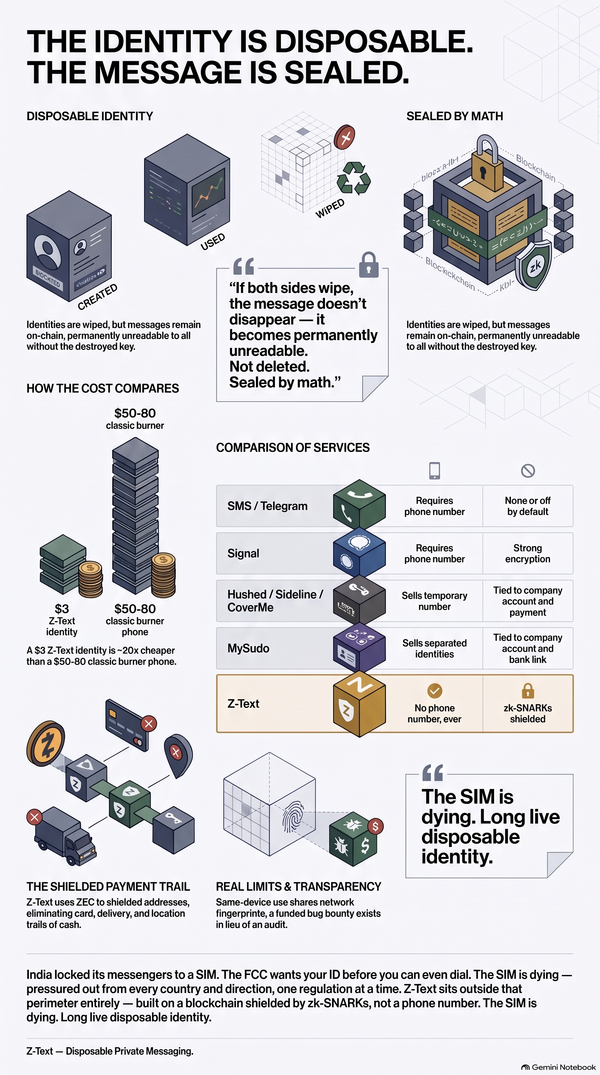
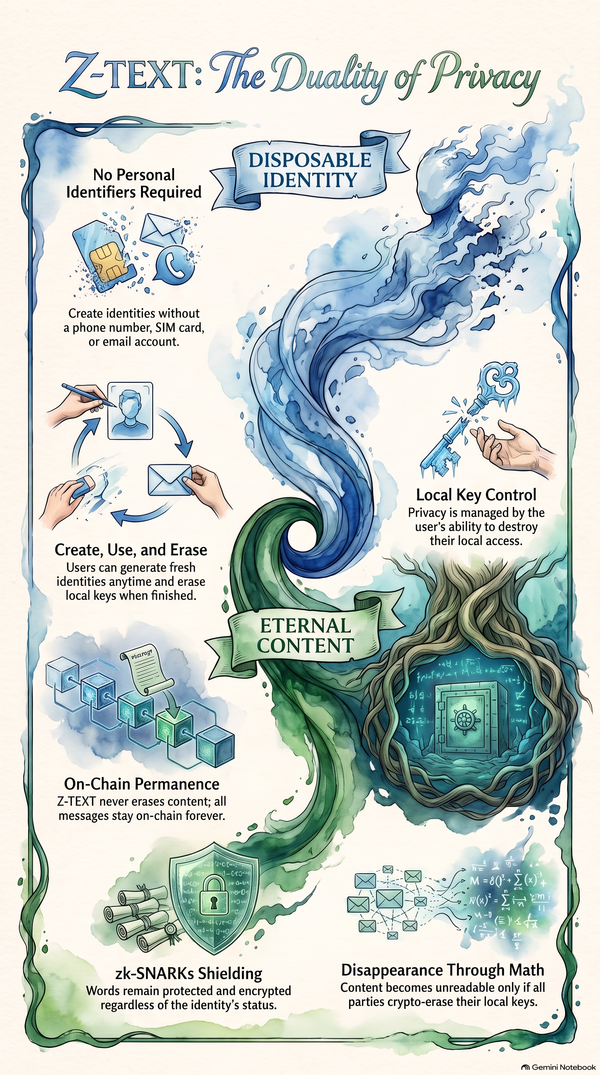
Z-TEXT has no central servers, no user accounts, no central database and no entity that can be subpoenaed for user data. Messages travel device-to-device via shielded blockchain transactions. The user holds the 24-word seed phrase — the sole key to identity, messages, wallet and password vault. Nothing to breach. Nothing to hand over.
| Message routing | G-stream mempool push — 1 to 5 seconds |
| Identity system | Cryptographic z-address only — no phone, no email |
| Key custody | User-held 24-word seed phrase — self-custodial |
| Legal exposure | No central entity to subpoena |
✅ Live in Production
⚛️ Layer 4 — NIST FIPS 203 ML-KEM-768 Post-Quantum Key Encapsulation
Z-TEXT now optionally wraps the classical X25519 key exchange with ML-KEM-768 (Module Lattice Key Encapsulation Mechanism, formerly CRYSTALS-Kyber), standardised as NIST FIPS 203 in August 2024. This provides resistance against Shor's algorithm attacks from quantum computers — protecting messages today against a "harvest now, decrypt later" threat model.
| Standard | NIST FIPS 203 (August 2024) |
| Algorithm family | Module Lattice (CRYSTALS-Kyber) |
| Security level | ML-KEM-768 — NIST Level 3 (AES-192 equivalent) |
| Hybrid mode | ML-KEM-768 + X25519 combined |
| Status in Z-TEXT | ✅ Live — not a roadmap item |
Reference: NIST FIPS 203 — ML-KEM Standard | Wikipedia — CRYSTALS-Kyber
📊 Full Stack — Competitive Matrix
| Layer | Z-TEXT | Signal | Telegram | |
|---|---|---|---|---|
| zk-SNARKs metadata | ✅ | ❌ | ❌ | ❌ |
| X25519 + Ed25519 E2E | ✅ | ✅ | ✅ | ⚠️ |
| Serverless / no accounts | ✅ | ❌ | ❌ | ❌ |
| ML-KEM-768 post-quantum | ✅ | ⚠️ PQ only | ❌ | ❌ |
| All 4 combined | ✅ Unique | ❌ | ❌ | ❌ |
Signal has post-quantum encryption — but runs on centralised servers. That means metadata (who talks to whom, when, how often) can be logged and subpoenaed. The serverless + zk-SNARK + classical + post-quantum combination is, to our knowledge, unique to Z-TEXT.
⚛️ Post-Quantum — How It Works in Practice
Optional Full PQ Protection — Per Contact, One Tap
ML-KEM-768 post-quantum protection in Z-TEXT is opt-in per contact. This is a deliberate design choice — not a limitation. The user decides which conversations get the full quantum shield, with a single tap to initiate a PQ handshake with each contact.
This matters especially for the "harvest now, decrypt later" threat model — where adversaries record encrypted traffic today, intending to decrypt it once quantum computers become powerful enough. Activating PQ per contact closes that window permanently for that conversation.
| 1️⃣ |
Open any contact in Z-TEXT Standard messages already protected by Layers 1–3 |
| 2️⃣ |
Tap — Activate Post-Quantum for this contact Z-TEXT performs ML-KEM-768 key encapsulation handshake |
| 3️⃣ |
All future messages to that contact — full 4-layer protection zk-SNARKs + X25519/Ed25519 + serverless + ML-KEM-768 active |
⚠️ Important — PQ Keys & Portability
ML-KEM-768 session keys are not derived from your 24-word seed phrase. This is a property of lattice-based cryptography — the key material cannot be deterministically regenerated from a seed. As a result, PQ handshakes are device-bound: if you reinstall Z-TEXT or move to a new device, a one-tap re-handshake with each contact is required to restore full PQ protection. Your messages, wallet and password vault remain fully recoverable via seed — only the PQ session layer needs re-establishing.
✅ Without PQ handshake — still strongly protected
Contacts without an active PQ handshake continue to receive full protection from the three base layers: zk-SNARKs metadata shielding, X25519 + Ed25519 end-to-end encryption, and the serverless zero-data architecture. The PQ layer is additive — its absence does not weaken existing protection.
PQ Portability — Z-TEXT vs Others
| Aspect | Z-TEXT | Signal |
|---|---|---|
| PQ live in production | ✅ | ✅ |
| No central server required | ✅ | ❌ |
| Metadata hidden on-chain | ✅ | ❌ |
| PQ derivable from seed | ❌ by design | ❌ by design |
| Re-handshake on new device | 1 tap / contact | Automatic* |
* Signal re-handshake is automatic because it uses central servers to coordinate — which is precisely what Z-TEXT eliminates.
Reference: NIST FIPS 203 — ML-KEM | Wikipedia — CRYSTALS-Kyber
⛓️ BitcoinZ Chain — Track Record
| Genesis block | 10 September 2017 |
| Years live | 8 years — no chain halts |
| Privacy model | Sapling zk-SNARKs — no premine |
| Governance | Community-driven — decentralised |
Source: getbtcz.com | Wikipedia — BitcoinZ
Open source · Self-custodial · 3-in-1: Messenger + Wallet + Password Manager
quantum proof messaging app · ML-KEM-768 messenger · NIST FIPS 203 messenger · zk-SNARKs secure chat · X25519 encrypted messenger · decentralized encrypted messenger · blockchain messaging privacy · zero-knowledge proof messenger · Signal alternative · best private messaging app · no phone number messaging app · censorship resistant messenger · post-quantum secure chat · stealth mode chat app · on-chain messaging solution