BTCZ Private Fees: 10,000× Less Than Zcash
We measured the real fee of a private transaction on the BitcoinZ blockchain, the network behind Z-TEXT, the privacy messenger with no phone number. Here is what it costs, and what it doesn't fix.


We measured the real fee of a private transaction on the BitcoinZ blockchain, the network behind Z-TEXT, the privacy messenger with no phone number. Here is what it costs, and what it doesn't fix.
Key findings
- A shielded BTCZ transaction pays a flat fee of 0.00001 BTCZ. The BitcoinZ code sets it, and 100 real transactions confirm it.
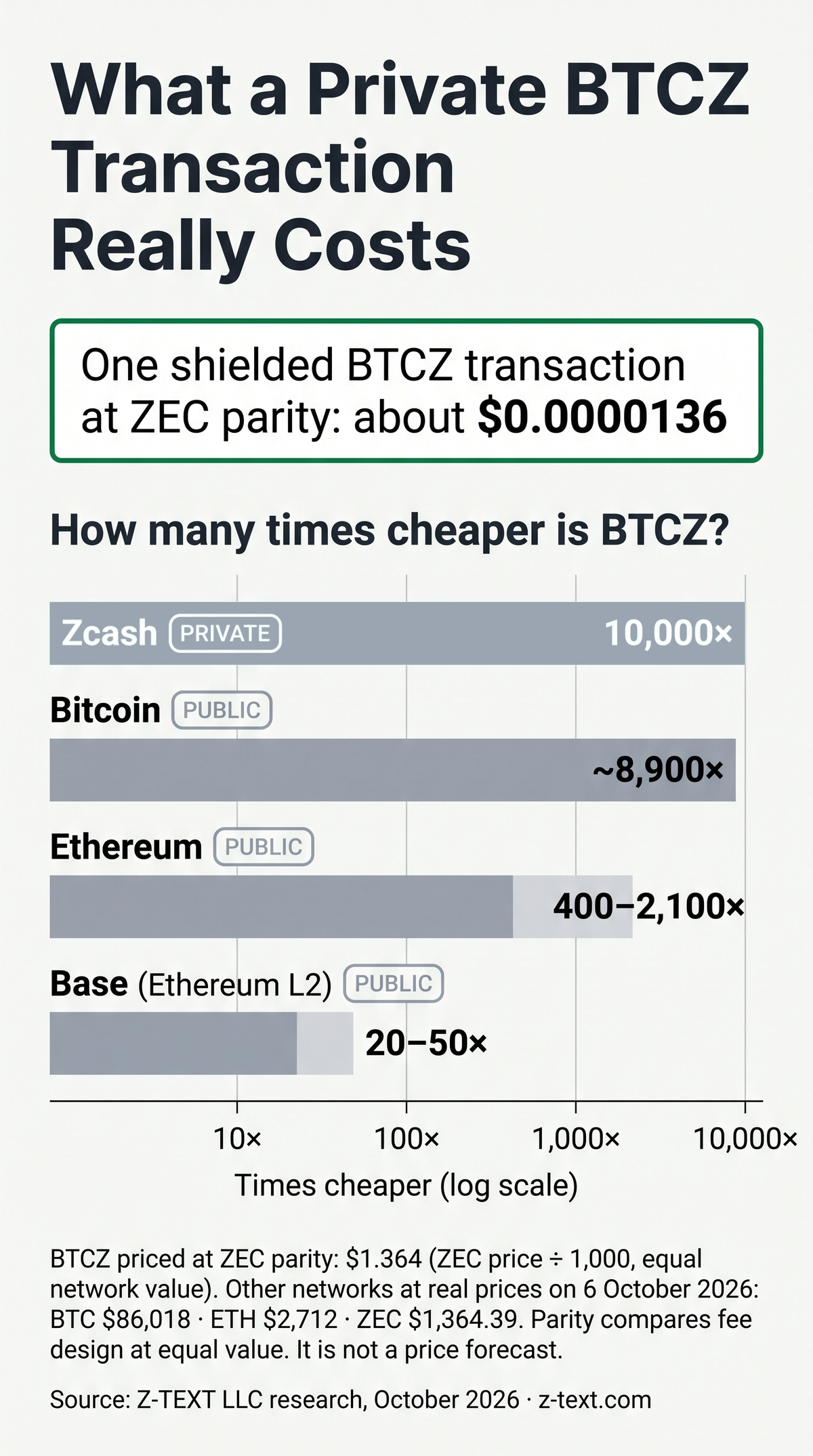
- At equal network value with Zcash, that fee is about $0.0000136: 10,000× less than the cheapest private Zcash transaction.
- It is also ~8,900× less than Bitcoin, 400–2,100× less than Ethereum and 20–50× less than Base. Those three are public.
- The honest limit: BTCZ is a small network. One profit-switching pool mines 75–90% of blocks, and large payments need a long wait to be safe.
- For Z-TEXT users, each message in a two-way chat finally costs only the 0.00001 BTCZ fee.
Z-TEXT sends every message as a shielded BTCZ transaction. Shielded means the sender, the receiver and the amount are hidden on the blockchain. The fee is the price of that privacy, so we checked it on the chain itself.
The full research paper, with every source and every limit, is here (DOI 10.5281/zenodo.23207859).
❓ 1. What does a private BTCZ transaction cost?
A private (shielded) BTCZ transaction costs 0.00001 BTCZ. That fee is written into the BitcoinZ code itself: the standard fee is 1,000 base units, and 100,000,000 base units make 1 BTCZ. (Source: BitcoinZ source code)
But code is a promise. The chain is the proof. So we checked 100 real transactions in 7 blocks, from April to October 2026. Every shielded transaction paid exactly 0.00001 BTCZ. Small or large, with 1 output or 5, the fee never moved. (Source: BitcoinZ explorer)
Exactly that.
How we checked: each block pays its miner a fixed 3,125 BTCZ plus every fee inside the block. Anything above 3,125 BTCZ is the exact fee total. No estimate, no guesswork.
Mini-resume
A shielded transaction on the BitcoinZ (BTCZ) blockchain costs a flat 0.00001 BTCZ, whatever its size. The BitcoinZ code sets this fee, and a sample of 100 real transactions from April to October 2026 confirms it: every shielded transaction paid exactly 0.00001 BTCZ.
❓ 2. Why compare at ZEC parity?
A network's value is its coin price times its number of coins. Cut a pizza into 1,000 times more slices, and each slice is worth 1,000 times less.
BitcoinZ (BTCZ) is Zcash at 1,000 times the scale:
- Supply: 21 billion BTCZ vs 21 million ZEC.
- New coins: 3,125 BTCZ vs 3.125 ZEC every 150 seconds.
So at equal value, one BTCZ is worth one thousandth of a ZEC: $1.364 on 6 October 2026, when ZEC traded at $1,364.39.
At that price, the BTCZ fee costs $0.0000136. The cheapest private Zcash transaction costs 0.0001 ZEC, about $0.14. (Source: ZIP-317)
Why 10,000× and not 1,000×? Parity already cancels the 1,000× supply gap. A perfect ×1,000 copy of Zcash would charge 0.1 BTCZ per private transaction. BTCZ charges 0.00001: 10,000 times less. The gap is pure fee design.
At BTCZ's real price, the gap would be 440 million×, but that only shows BTCZ's small market value. Parity compares design. It's not a price forecast.
Mini-resume
BitcoinZ (BTCZ) is designed as Zcash at 1,000 times the scale, in both coin supply and coin issuance. At equal network value, one BTCZ is worth one thousandth of a ZEC, $1.364 on 6 October 2026. A perfect ×1,000 copy of Zcash would charge 0.1 BTCZ per private transaction; BTCZ charges 0.00001 BTCZ, about $0.0000136, against about $0.14 on Zcash. That 10,000× gap comes purely from fee design. Parity is not a price forecast.
❓ 3. Is BTCZ cheaper at any price?
Almost. In coins, the Zcash fee is 10 times bigger: 0.0001 ZEC against 0.00001 BTCZ. So both fees cost the same in dollars only when one BTCZ is worth 10 times one ZEC.
Today, that would mean $13,644 per BTCZ. That's 440 million times the current BTCZ price. With 1,000 times more coins, the BitcoinZ network would be worth 10,000 times the whole Zcash network.
Below that, BTCZ is cheaper. Realistically, that's always.
But fees are rules, and rules can change. Zcash is working on a dynamic fee that would follow network demand, still a proposal in 2026. And BTCZ could raise its own fee if blocks ever fill up. (Source: Forklog)
Mini-resume
The Zcash fee is 10 times larger in coins than the BitcoinZ (BTCZ) fee: 0.0001 ZEC against 0.00001 BTCZ. The two fees would cost the same in dollars only if one BTCZ were worth 10 times one ZEC, about $13,644 on 6 October 2026, which is 440 million times that day's BTCZ price. Below that price, a private BTCZ transaction is cheaper, as long as both fee rules stay unchanged.
❓ 4. How does BTCZ compare with Bitcoin, Ethereum and Base?
At ZEC parity, one shielded BTCZ transaction costs about $0.0000136. Here's what a simple transfer costs elsewhere, at real prices on 6 October 2026. How many times cheaper is BTCZ?
Zcash · private · 0.0001 ZEC, about $0.14
Bitcoin · public · about $0.12
Ethereum · public · $0.0057 to $0.028
Base (Ethereum Layer 2) · public · $0.0003 to $0.0007
Bars on a log scale. BTCZ priced at ZEC parity ($1.364); other networks at real prices on 6 October 2026 (BTC $86,018 · ETH $2,712 · ZEC $1,364.39).
But this isn't a like-for-like comparison. Those three fees buy a public transaction: the sender, the receiver and the amount stay visible to anyone, forever. A shielded BTCZ transaction hides all three.
Cheaper. And private.
Market fees also move. Bitcoin, Ethereum and Base let users bid for space, so fees jump when the network gets busy. On the April 2024 halving block, the median Bitcoin fee hit 1,805 satoshis per vbyte, over 1,000 times its quiet level. BTCZ's fee is fixed in its code, so it doesn't spike. (Sources: Spark, CryptoTicker, ethereum.org, Base docs)
Mini-resume
At ZEC parity, a shielded BitcoinZ (BTCZ) transaction costs about $0.0000136. A simple transfer costs about $0.12 on Bitcoin, $0.0057 to $0.028 on Ethereum and $0.0003 to $0.0007 on Base, at 6 October 2026 prices: BTCZ is about 8,900×, 400 to 2,100× and 20 to 50× cheaper. Bitcoin, Ethereum and Base transactions are also public, while a shielded BTCZ transaction hides the sender, the receiver and the amount.
❓ 5. What are the honest limits?
BTCZ's low fee is real. But it runs on a small network.
Yes, we're pointing out the weak spots of the chain we build on. That's the point.
1. Mining is concentrated
- One pool, zpool, mines about 75–90% of BTCZ blocks.
- Its software sends miners to whichever coin pays best.
- So its share can rise or drop fast.
2. Attacks are cheap, but there's little to gain
- Renting a majority of BTCZ's mining power for one hour costs about $1 (Crypto51 estimate).
- An attacker could delay or reverse recent transactions.
- An attacker could NOT read shielded messages, change them, or spend your coins.
- The risk is for whoever receives a large payment from a stranger: wait before treating it as final.
- To our knowledge, BTCZ has never had a 51% attack.
3. Large payments need patience
- $10: safe after about 5.5 hours.
- $1,000: safe after about 23 days.
- Small payments and messages: fine.
4. Liquidity is thin
- About $6,000 of BTCZ traded per day (CoinGecko, 6 October 2026).
- Buying or selling large amounts is hard.
5. The fee is untested under load
- Blocks are less than 10% full today.
- If they filled up, miners would favour higher fees.
And none of these comes from BTCZ's fee design. They come from its size. More miners, more trading venues and a higher network value would fix most of them.
Mini-resume
- BTCZ mining is concentrated: one profit-switching pool mines about 75–90% of blocks.
- A majority attack on BTCZ is cheap but has never happened; it cannot read or change shielded messages or steal coins, and only threatens large payments accepted too fast.
- Small BTCZ payments are safe quickly; a $1,000 payment needs about 23 days.
- BTCZ trading volume is thin, about $6,000 per day.
- The BTCZ fee has not been tested under heavy load.
- All five limits come from the network's small size, not from its fee design.
❓ 6. What does it mean for Z-TEXT users?
Z-TEXT sends every message as a shielded BTCZ transaction. So the fee you just read about is the real cost of a private message.
What one message costs
- Each message sends 0.00011 BTCZ: 0.0001 to your contact + the 0.00001 network fee.
- The 0.0001 isn't spent. It comes back when your contact replies.
- So in a two-way chat, each message finally costs only 0.00001 BTCZ: about $0.0000136 at ZEC parity.
- A one-way message costs 0.00011 BTCZ (0.00021 if you keep a copy of sent messages on-chain).
Channels
- One channel post is one transaction, whatever the audience.
- 10 followers or 10,000 cost the same.
Speed
- Your contact sees the message in 1 to 5 seconds.
- The blockchain confirms it in about one block, roughly 2.5 minutes.
Privacy
- The message travels encrypted inside the transaction (AES-256-GCM, about 480 characters).
- Only your contact can read it.
- Sender, receiver and amount are hidden on the chain. Your IP address and timing are network-level data that shielding alone doesn't hide.
Why the limits barely touch you: messages carry tiny amounts. The network's weak spot, slow safety for big payments, doesn't apply to a 0.00011 BTCZ message.
Honest note: the Z-TEXT app hasn't been independently audited yet. A public bug bounty is open. Reading messages and channels is free; sending needs a license code, from $3 a month, at z-text.com/packages. BitcoinZ itself lives at getbtcz.com.
Mini-resume
- Each Z-TEXT message is a shielded BTCZ transaction that sends 0.00011 BTCZ.
- In a two-way Z-TEXT chat, each message finally costs only the 0.00001 BTCZ network fee.
- A Z-TEXT channel post costs one transaction, whatever the number of followers.
- Z-TEXT messages appear in 1 to 5 seconds and are confirmed in about 2.5 minutes.
- Only the recipient can read a Z-TEXT message; sender, receiver and amount are hidden on-chain.
- The Z-TEXT app is not yet independently audited; a public bug bounty is open.
Read the full research paper, with every figure, source and limit: What a Private BTCZ Transaction Really Costs (DOI 10.5281/zenodo.23207859).
Sources
- BitcoinZ source code (fee rule, src/policy/fees.h)
- BitcoinZ block explorer (100-transaction sample)
- ZIP-317, Zcash fee mechanism
- CoinGecko, BitcoinZ (price, volume)
- Crypto51, cost of a 51% attack
- Spark, mempool and the April 2024 fee spike
- CryptoTicker, Bitcoin fees at 1 sat/vB
- ethereum.org, Building on Ethereum in 2026
- Base docs, network fees
- Forklog, Zcash dynamic fee proposal
- Full research paper · DOI 10.5281/zenodo.23207859
Keywords: blockchain messenger · private messaging app · zero-knowledge proof messenger · on-chain messaging solution · BitcoinZ fees · Zcash fees · private transaction cost · Signal alternative · no phone number messaging app
🔗 Also read: Signal vs Z-TEXT · WhatsApp vs Z-TEXT · Session vs Z-TEXT · Telegram vs Z-TEXT · Z-TEXT 4-in-1 · The Third Man