It's the ID, Stupid: Z-TEXT's 24-Word Line of Defense
Nobody broke the encryption. They stole the ID. Phone, email, SIM, KYC: every usual ID ends up in a breach. Z-TEXT replaces them with 24 words that never leave your phone and sit in no database. Here is how it works, and its honest limits.
Phone, email, SIM, KYC: every usual ID ends up in a breach. Here's why 24 words on the blockchain beat them all.
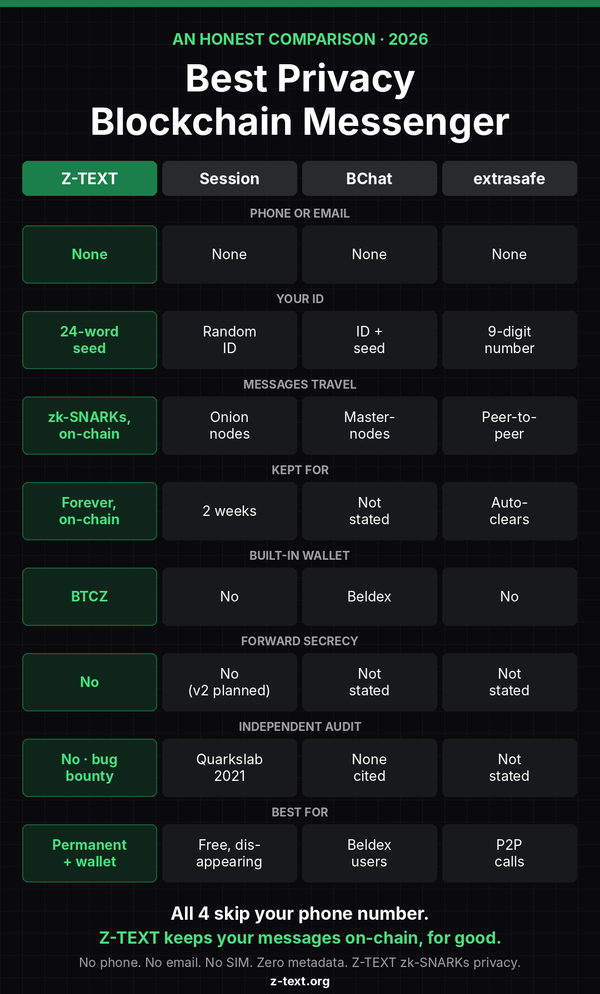
Nobody broke the encryption. They stole the ID. That is the story behind almost every big hack of 2026. Z-TEXT is a private messenger built on the BitcoinZ blockchain that asks for no phone number, no email, no SIM and no KYC. Z-TEXT gives you a different kind of identity: 24 words that only you hold.
Mini-resume
Most 2026 hacks did not crack encryption. Attackers stole identity data instead: phone numbers, SMS codes, emails, ID documents and metadata, usually from company databases. Z-TEXT replaces the usual ID with a blockchain ID made from 24 words that are never stored in any database. Those 24 words cannot be guessed, but they must be guarded, because whoever holds them holds the account.
❓ 1. Why is being online so dangerous right now?
Because attackers stopped fighting the math. Encryption, the scrambling that makes a message unreadable without the right key, mostly holds. So hackers go around it, through your identity.
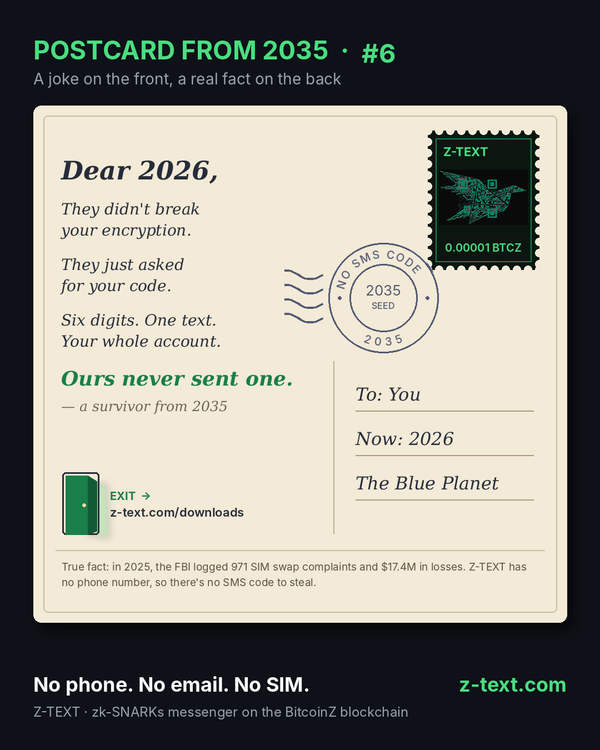
Look at the last few months. In March 2026, the FBI and CISA warned that thousands of Signal and WhatsApp accounts had been hijacked. The attackers posed as support staff and tricked users into handing over their verification codes. The encryption was never touched (UNITED24 Media).
Then the databases. Hackers published over a million Harvard and Penn alumni and donor records, with names, home addresses and phone numbers (TechRadar). In November, about 851,000 Harvard email addresses landed on Have I Been Pwned (eSecurity Planet). DigiCert, a security company, leaked customer emails and phone numbers, and some passports and driver's licenses (Cybersecurity News). Even Chainalysis, the firm that traces crypto users, lost customer names and emails to an AI-agent attack (BleepingComputer).
It's the ID, stupid.
Mini-resume
In 2026, attackers rarely break encryption. They steal identity: verification codes in the FBI-reported Signal and WhatsApp takeovers, and names, emails, phone numbers and ID documents in the Harvard, Penn, DigiCert and Chainalysis breaches.
❓ 2. What is the "usual ID" online?
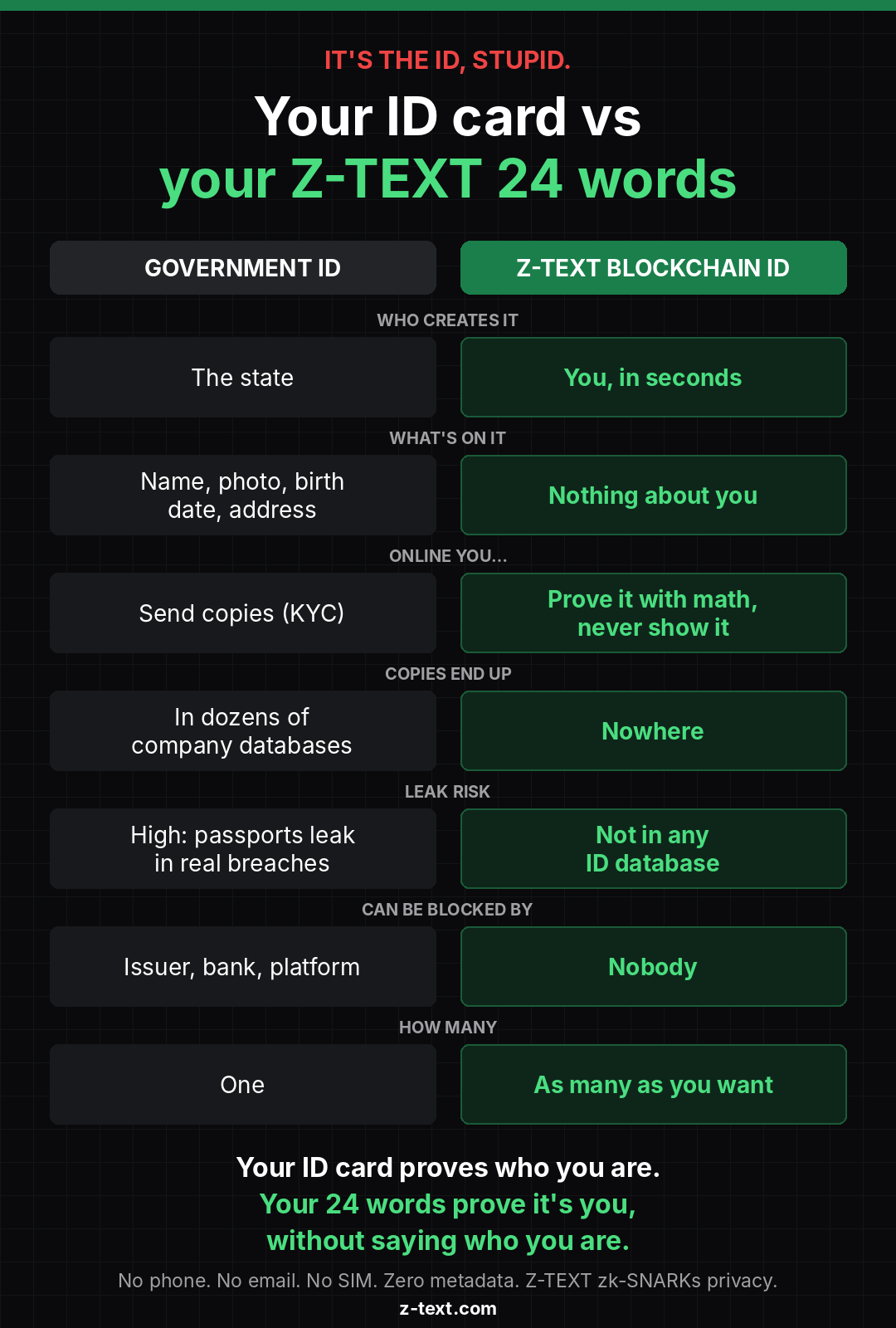
Your usual online ID is not one thing. It is five pieces, spread across many companies.
Every company that holds one piece is one more door. And you don't control any of those doors.
Mini-resume
The usual online ID has five pieces: phone number, email, SIM card, KYC documents and metadata. Each piece is stored by other companies, so each one can leak without you doing anything wrong.
❓ 3. Why is metadata part of your ID?
Metadata is the data about your messages, not the messages themselves. Who you wrote to. At what time. How often. From where.
That sounds harmless. It isn't. A list of who you talk to every night at 11 pm describes your life better than your passport does. Metadata identifies you even when your name appears nowhere.
This is why "end-to-end encrypted" is not the whole story. The message can be locked while the envelope stays readable.
Mini-resume
Metadata is who you contact, when and how often. It can identify a person without any name, which makes it part of your identity even in apps that encrypt the message content.
❓ 4. What is a Z-TEXT blockchain ID?
A Z-TEXT blockchain ID starts with 24 words, called a seed phrase. Z-TEXT creates them on your phone. Nobody else ever sees them.
Here's the part most people get wrong: the 24 words are not stored on the blockchain. They never leave your device. From those words, Z-TEXT calculates your keys, using the Zcash Sapling standard called ZIP-32. From the keys, Z-TEXT makes your shielded address, your public mailbox, which reveals nothing about you.
When you send a message, a zk-SNARK proves to the blockchain that the owner of the key approved it. A zk-SNARK is a zero-knowledge proof: math that proves something is true without showing the secret behind it. The blockchain checks the proof and records your encrypted message. So the blockchain knows it's you, without knowing who you are.
To be clear, a Z-TEXT ID does not replace your ID card. You can't open a bank account or cross a border with it. They do different jobs.
Your ID card proves who you are. Your 24 words prove it's you, without saying who you are.
Mini-resume
A Z-TEXT blockchain ID is a set of keys calculated from 24 words that never leave your phone. The BitcoinZ blockchain verifies a zk-SNARK proof that you hold the key, without ever seeing the key or learning who you are. Unlike a government ID card, it carries no personal data and leaves no copies in company databases.
❓ 5. Do 24 words really beat phone, email, SIM and KYC?
As a target for hackers, yes. Clearly.