Can Quantum Attacks Break Z-TEXT's Wallet or Messages?
A real IonQ blueprint targets Bitcoin's signature scheme. Wallet theft, message content, and the one honest limit — with the actual numbers.
On September 8, 2026, IonQ published the first complete engineering blueprint for breaking Bitcoin's elliptic-curve signatures with a quantum computer. Real company, real numbers, three days ago. Z-TEXT runs on a blockchain too — so here's the plain answer: what's protected, what isn't, and why it isn't the same story as Bitcoin.
Quick answer: While Bitcoin-style wallets sit exposed to a real, published attack blueprint today, Z-TEXT already closed that door — and closed the messaging door too, permanently.
Two real doors, already closed:
1. Wallet theft — A transparent Bitcoin wallet exposes its signing key the moment you spend. That's exactly what IonQ's blueprint targets. Z-TEXT's shielded wallet never exposes that key, at any point.
2. Message content — Every Z-TEXT conversation already runs on a dedicated post-quantum lock (ML-KEM-768), automatically, today. This isn't a temporary head start — ML-KEM-768 is built specifically so that even a fully working, future quantum computer cannot break it. Your messages stay unreadable whether that computer arrives in 10 years or never.
The one thing still shared with everyone else: the math hiding sender, receiver, and amount is the same elliptic curve cryptography (ECC) securing HTTPS, online banking, and VPNs worldwide. Nobody's cracked it yet — real quantum hardware for that is still 10-20 years out.
❓ 1. What did IonQ actually publish?
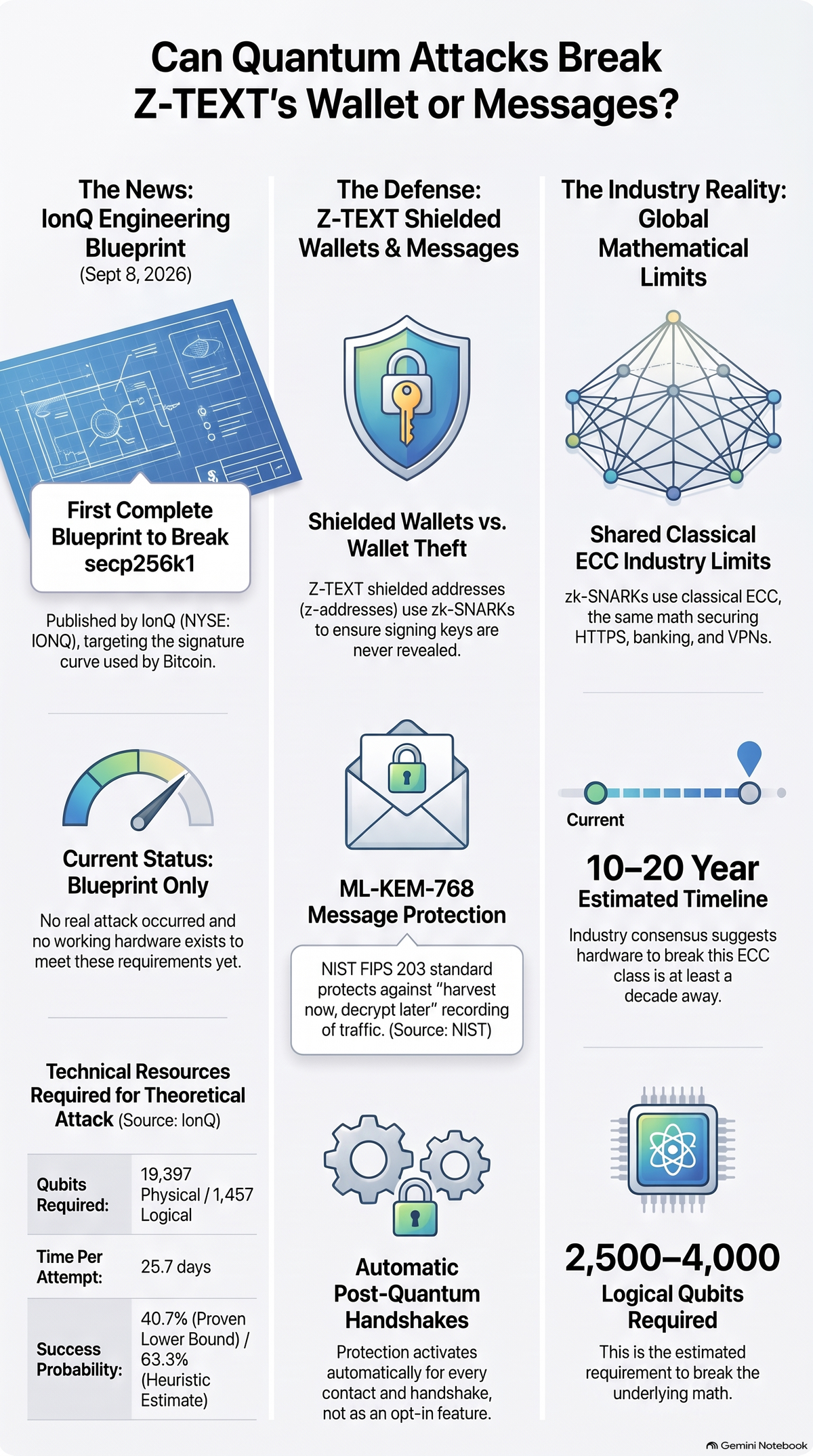
IonQ, a publicly traded quantum computing company (NYSE: IONQ), released a full engineering blueprint — not a demonstration — showing exactly how a future quantum computer could break secp256k1, the specific elliptic curve Bitcoin uses to sign transactions.
The numbers: 19,397 physical qubits, 1,457 logical qubits, an estimated 25.7 days per attempt, with a proven lower bound of 40.7% success probability per attempt (IonQ notes this could run as high as 63.3% under common mathematical heuristics, but 40.7% is the number they actually proved).
This did not happen on a real quantum computer. No attack took place. IonQ's own roadmap targets 10,000 fault-tolerant physical qubits by 2027 — half of what this specific attack would need. The company itself calls this "a capability milestone first, a security finding second."
❓ 2. Why doesn't this attack reach Z-TEXT's wallet?
IonQ's blueprint specifically targets secp256k1 — the curve used by transparent, Bitcoin-style addresses. The attack works because spending from a transparent address exposes the public key, either already sitting on-chain from a past spend, or revealed the moment a new transaction is broadcast. That exposed key is the actual target Shor's algorithm needs.
Z-TEXT's shielded (z-address) transactions don't have that exposure point. The zk-SNARK proof mathematically confirms a spend is valid without ever revealing the key that authorized it — not at rest, not even during spending. There's no equivalent moment where a public key becomes available to attack.
This isn't a different level of mathematical security — the underlying curves are still classical, still eventually breakable by a large enough quantum computer. The difference is opportunity: transparent addresses hand over a target. Shielded addresses never do.
❓ 3. What about "harvest now, decrypt later"?
This is a different risk from the wallet-theft question above — it's not about stealing funds, it's about someone recording your encrypted messages today and reading them years later, once a powerful enough quantum computer exists.
Z-TEXT's messaging layer defends against this directly. Every conversation's key exchange uses ML-KEM-768, a NIST-standardized post-quantum algorithm (FIPS 203) — not a classical, quantum-breakable method. This isn't optional or something you have to activate: it runs automatically, on every handshake, for every contact, as part of how a connection is established at all.
Concretely: even if someone captures and stores every encrypted Z-TEXT message you ever send, a future quantum computer capable of breaking today's classical encryption still couldn't decrypt that traffic — because the key exchange was never built on the classical math that computer would be attacking.
This is separate and different from the wallet-theft question in Section 2. That was about zk-SNARKs hiding a spending key from an attacker. This is about the message encryption itself already being built on math quantum computers can't break, full stop — not hidden, just fundamentally different math.
Post-quantum protection, at a glance:
• NIST-standardized: Every conversation's key exchange uses ML-KEM-768 (FIPS 203) — not a classical, quantum-vulnerable method.
• Automatic, not opt-in: Runs on every handshake, for every contact, as part of how a connection is established.
• Built for the threat, not just today: The math is specifically designed and standardized to resist quantum computation — not the classical methods Shor's algorithm is expected to eventually defeat.
While Z-TEXT's wallet protection relies on zk-SNARKs to prevent key exposure, its messaging security relies on cryptography built for a different, quantum threat model entirely.
❓ 4. What zk-SNARKs don't protect against
zk-SNARKs aren't post-quantum technology. The math underneath (the same used by Zcash) is classical elliptic curve cryptography — the same family Shor's algorithm is expected to eventually break.
But this doesn't cancel the win from Section 2. zk-SNARKs give Z-TEXT a real advantage against theft — no exposed key, ever — and that advantage holds regardless of whether the underlying math is post-quantum or not. What zk-SNARKs don't do is make the ledger shielding itself (hiding sender, receiver, amount) immune to a future quantum computer. That's a separate question from theft, and it's still classical math — same as literally every blockchain today.
For scale: breaking this class of cryptography needs roughly 2,500-4,000 error-corrected logical qubits. Today's real quantum computers have a handful. Most researchers put this 10-20 years out.
"Same math. Higher barrier. zk-SNARKs don't change what's theoretically possible — they change what Z-TEXT's messenger actually exposes."
Sources
1. IonQ — "We Just Published the First Full-Stack Blueprint for Breaking 256-Bit Elliptic-Curve Signatures" (official company blog, September 8, 2026)
2. IonQ — Official investor press release
3. Interesting Engineering — "World's First Quantum Blueprint Maps Bitcoin's Keys Cracked in 26 Days"
4. H33 — "ZK-SNARKs Explained" (Groth16/Zcash Sapling confirmation, qubit estimates, 10-20 year timeline)
quantum attack messenger · zk-SNARKs quantum resistance · post-quantum blockchain messenger · harvest now decrypt later · quantum-resistant messaging app · Bitcoin quantum computer · Z-TEXT zk-SNARKs
🔗 Also read: Signal vs Z-TEXT · WhatsApp vs Z-TEXT · Session vs Z-TEXT · Telegram vs Z-TEXT · Z-TEXT 4-in-1 · The Third Man
Can Quantum Attacks Break Z-TEXT's Wallet or Messages?