
Best Mnemonic Memory Messenger: Why Z-TEXT Never Forgets
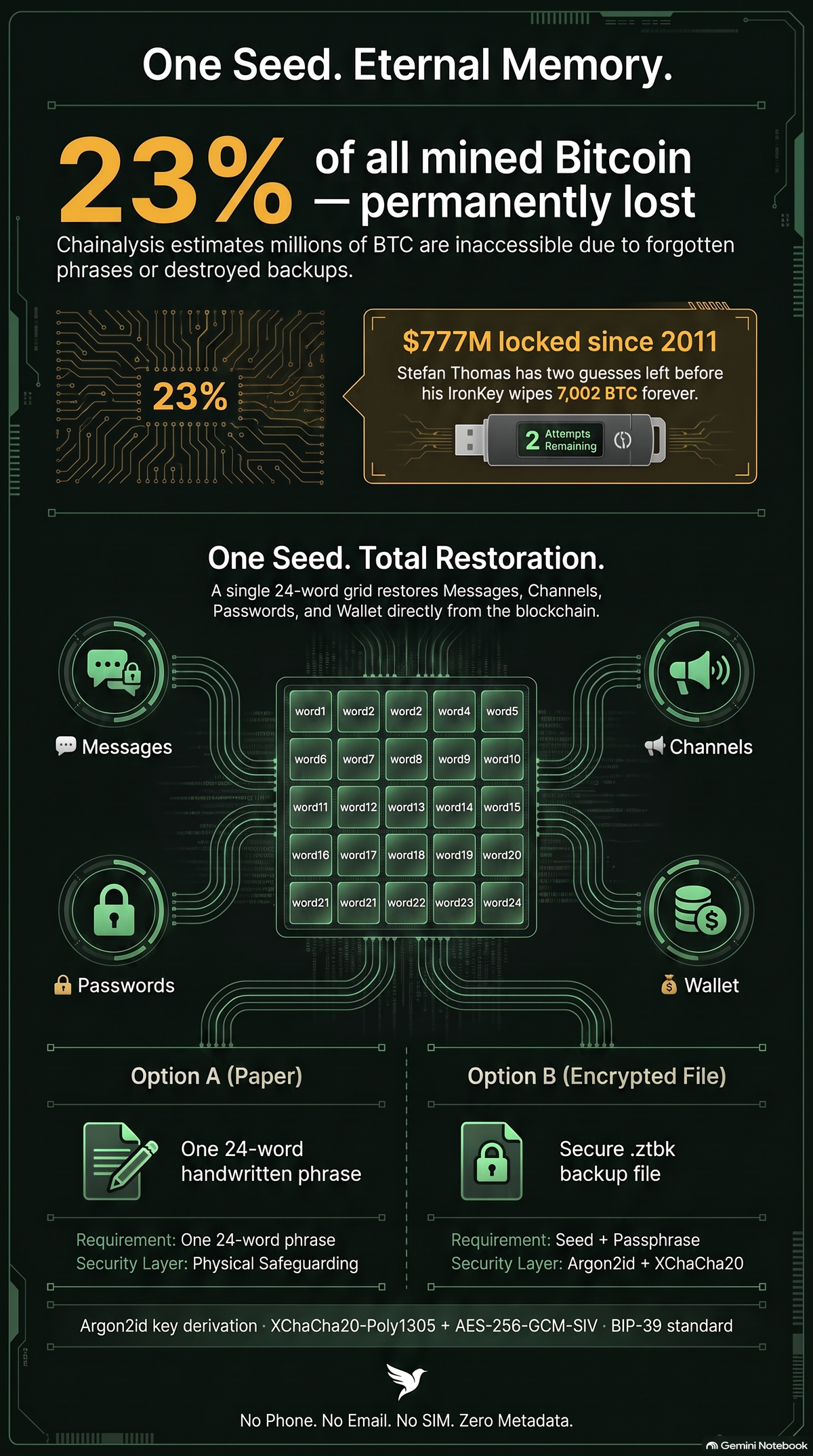
23% of all mined Bitcoin is permanently lost — not to hackers, but to forgotten seed phrases. Z-TEXT's Eternal Memory restores everything from one 24-word seed. Test your own recall with the Mnemonic Memory Challenge.
Z-TEXT is a zk-SNARKs blockchain messenger. Nobody reads your messages but you. The hard part was never convincing people the blockchain remembers forever — it does, by design. The hard part is that the person holding the seed phrase doesn't always remember it back. This is what that gap actually costs, and what Z-TEXT does about it.
Why do people lose crypto forever, even though the blockchain never deletes anything?
Because the wallet was never the vulnerable part — the human holding the words to it was. A seed phrase isn't a password that gates access to funds stored somewhere else; it mathematically is the wallet. Every address a wallet has ever generated or will ever generate derives from that one phrase. There's no company database with a copy, no support line that can look one up, and no "forgot password" flow.
The scale is real: blockchain analytics firm Chainalysis estimates as much as 23% of all mined bitcoin — several million BTC — is permanently inaccessible, largely through forgotten phrases, destroyed backups, and deaths with no inheritance plan for the words. No hacker, no exploit — just a wallet nobody can open anymore.
The clearest single case: programmer Stefan Thomas received 7,002 BTC in 2011 for making an explainer video, worth about $2,000 at the time. He stored the private keys on a password-protected IronKey drive and lost the paper with the password. The device wipes itself after 10 wrong guesses; he has used eight. That bitcoin is now worth roughly $777 million — sitting untouched, not because of a hack, but because of a lost piece of paper.
What does "eternal memory" actually mean on Z-TEXT?
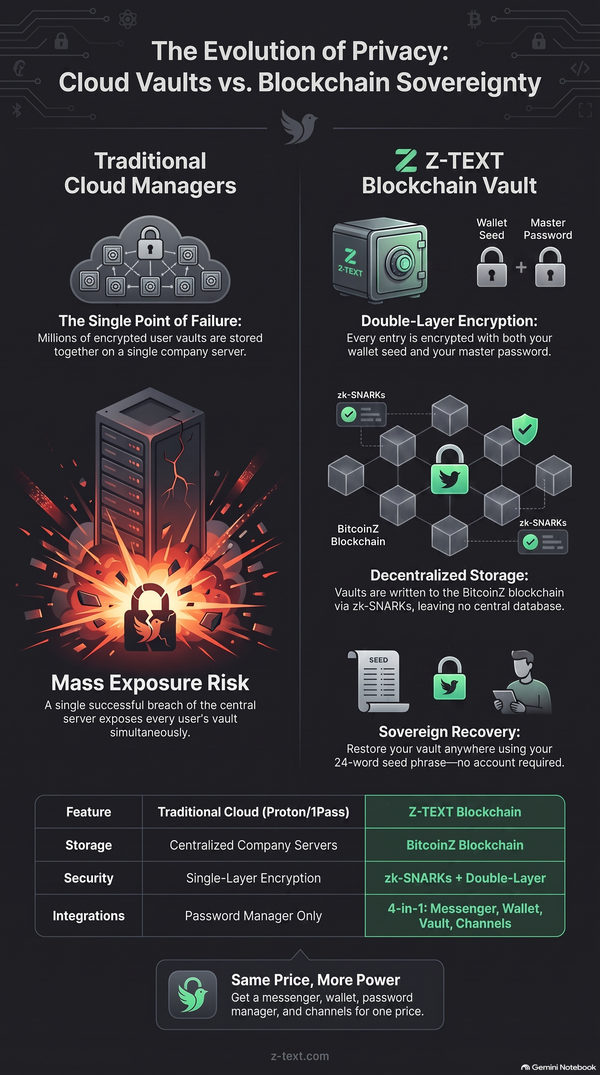
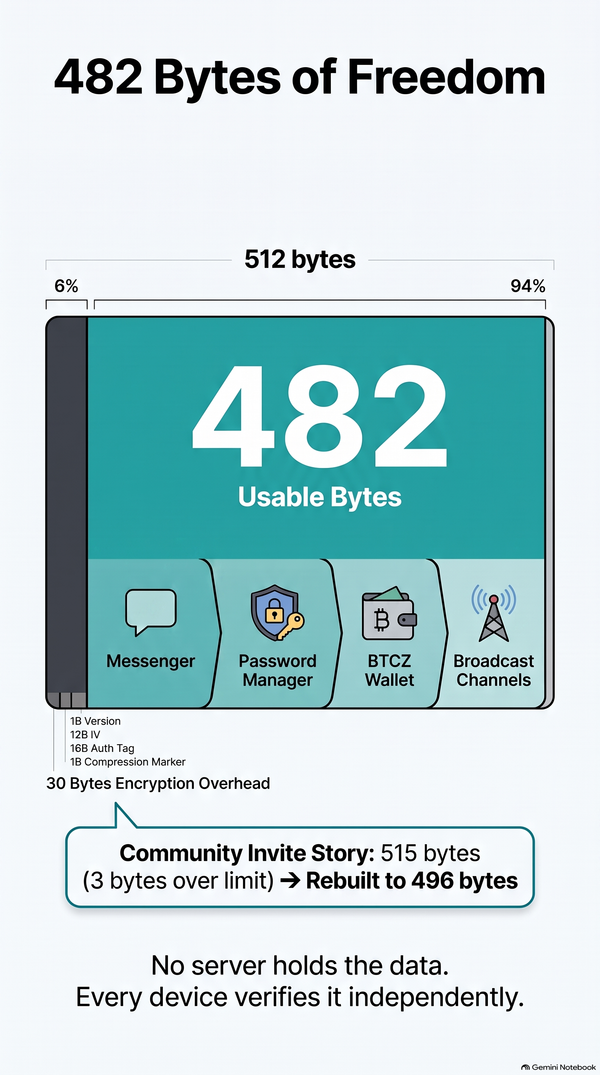
It means one seed phrase restores everything, not just the wallet. Z-TEXT combines a shielded messenger, a BTCZ wallet, on-chain Channels, and a blockchain password manager in a single app — and all of it is written to the BitcoinZ blockchain, not to a Z-TEXT server. Restore the 24-word seed on any device, and the app rescans the chain to rebuild the wallet, contacts, received messages, channels, and saved passwords.
Sent messages restore too, if "Keep sent messages on-chain" was turned on before sending. Messages in chats upgraded to post-quantum encryption stay on their original device by design — not even the seed brings those back, which is what preserves their forward secrecy.
What are the two ways Z-TEXT lets you back up that seed?
Both protect the exact same seed — it's a choice of storage method, not two different wallets.
Write the words by hand, in order. The app quizzes a few word positions afterward to confirm they were captured correctly.
A portable file for USB or cloud storage, sealed with a second, separately-generated 24-word passphrase.
The file itself contains only the 24-word seed and a small timestamp — nothing else. It's locked with two layers of authenticated encryption, XChaCha20-Poly1305 wrapped around AES-256-GCM-SIV, with the encryption key derived from the backup passphrase using Argon2id. File alone, without the passphrase: an unreadable ~1MB blob. Passphrase alone, without the file: nothing to unlock. Both are required together.
Do you need to remember two 24-word phrases?
No. Only one is required — the wallet seed. The second phrase only exists if you choose the optional encrypted backup file instead of writing the seed on paper. Pick paper, and there's just the one phrase, the same as any other BIP-39 crypto wallet on the market.
It's also not possible to skip the first phrase entirely and deal only with the second. Every wallet displays the 24-word seed once during setup, and the app requires confirming a few requested word positions before moving on — that step happens no matter which backup method gets chosen afterward. What changes is what happens next: pick the encrypted file, and there's no need to write down or remember that seed again. The file holds it, locked behind the second passphrase — which becomes the only thing left to personally safeguard going forward.
Why can't the backup-file passphrase just be a password you choose yourself?
Because most people would pick something guessable — a pet's name, a birthday, a favorite phrase. That kind of password gives a false sense of security on something guarding real funds. Z-TEXT auto-generates the backup passphrase from the same 2,048-word list used in the official BIP-39 standard, then derives the encryption key from it using Argon2id — a memory-hard function specified in RFC 9106, deliberately slow enough to resist brute-force and side-channel attacks. A full 24-word BIP-39 phrase carries roughly 256 bits of entropy; no password a person would choose and remember comes close.
Is any backup method actually risk-free?
No — and Z-TEXT doesn't pretend otherwise. Paper can be lost, burned, or read by the wrong person. An encrypted file can be deleted, corrupted, or stranded in an account that's lost. Neither method removes risk; each just moves it somewhere different.
Hardware chip wallets take a different approach entirely: the seed is generated and sealed inside a physical chip and is never shown to the user as words at all, not even once. That removes human-memory risk completely, but trades it for pure physical risk — lose or damage both cards in a two-card set, or expose them to something like a strong magnetic field, and the funds can be gone with no words to fall back on anywhere.
Can you test your own memory before real funds are on the line?
Yes — that's what the Mnemonic Memory Challenge is for. It's a safe, no-stakes practice round: pick Easy (6 words) or Elephant (12 words), study a picture-and-word pairing, then try to recall it from memory alone. Three context hints are available per word before an honest surrender option reveals the answer. The 4-letter autocomplete mirrors real BIP-39 wallet software directly — the official wordlist is designed so the first four letters of any word are enough to uniquely identify it.
Sample leaderboard (not live data): Captain Zero Trace , Snarky_, Shielded Ghost, zkPhantom, plus your own live score as "You."
What's the real risk, in one sentence?
It was never the blockchain. Z-TEXT's wallet, messages, channels, and passwords all restore from one seed, permanently — the only open question the Mnemonic Memory Challenge answers is whether the person holding that seed would remember it back.
Sources:
BIP-39 spec (Bitcoin Improvement Proposals, GitHub) — https://github.com/bitcoin/bips/blob/master/bip-0039.mediawiki
RFC 9106 — Argon2 Memory-Hard Function (IETF/CFRG) — https://www.rfc-editor.org/rfc/rfc9106.html
Bitcoin.com News — "Seed Phrases: The 12 Words Standing Between You and Losing Everything" (Chainalysis stat) — https://news.bitcoin.com/learning-insights/bitcoin-seed-phrase-explained/
Gulf News — "Bitcoin: Meet Stefan Thomas who lost $777 million to a forgotten password"
Z-TEXT Docs — Backup & Recovery — https://z-text.com/docs/backup-recovery
Electric Coin Company — What are zk-SNARKs? — https://z.cash/learn/what-are-zk-snarks/
seed phrase memory · BIP-39 · encrypted backup file · blockchain password manager · zk-SNARKs messenger · BitcoinZ
🔗 Also read: 482 Bytes of Freedom · Blockchain Password Manager · Z-TEXT: Only Messenger With These 3 Things · Best No Phone No Metadata Messenger
![Telegram Channels Banned Today - Live Tracker [Auto-Updated]](https://storage.ghost.io/c/fd/15/fd15bb3d-d8d8-469e-8b80-b94dae7aa4cd/content/images/size/w600/2026/08/paria_to_king_infographic.webp)